Ch. 2 - Limits
Briggs - Calculus: Early Transcendentals 3rd Edition
Briggs3rd EditionCalculus: Early TranscendentalsISBN: 9780136847243Non è quello che usi tu?Cambia libro di testo
Capitolo 2, Problema 2.14

Describe the end behavior of g(x) = e-2x.

Guida verificata passo dopo passo
1
Consider the function \(g(x) = e^{-2x}\).
Recall that the exponential function \(e^x\) has a horizontal asymptote at \(y = 0\) as \(x \to -\infty\).
For \(g(x) = e^{-2x}\), as \(x \to \infty\), the exponent \(-2x\) becomes very large and negative, making \(e^{-2x}\) approach 0.
As \(x \to -\infty\), the exponent \(-2x\) becomes very large and positive, making \(e^{-2x}\) grow without bound.
Thus, the end behavior of \(g(x)\) is: as \(x \to \infty\), \(g(x) \to 0\); as \(x \to -\infty\), \(g(x) \to \infty\).

Risposta video verificata per un problema simile:

Questa soluzione video è stata consigliata dai nostri tutor come utile per risolvere questo problema.
Durata del video:
3m

Concetti chiave

Ecco i concetti essenziali che devi comprendere per rispondere correttamente alla domanda.

End Behavior of Functions

End behavior refers to the behavior of a function as the input values approach positive or negative infinity. It helps in understanding how the function behaves at the extremes of its domain, which is crucial for sketching graphs and analyzing limits.
Video consigliato:
5:46
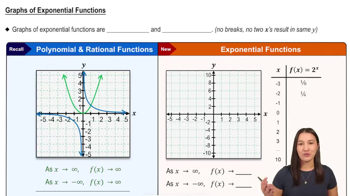
Graphs of Exponential Functions

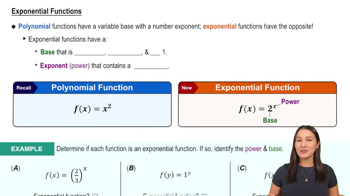
Exponential Functions

Exponential functions are mathematical expressions of the form f(x) = a * b^x, where 'a' is a constant, 'b' is a positive base, and 'x' is the exponent. The function g(x) = e^(-2x) is an example, where 'e' is the base of natural logarithms, and the negative exponent indicates a decay as 'x' increases.
Video consigliato:
6:13
Exponential Functions

Limits at Infinity

Limits at infinity are used to determine the value that a function approaches as the input grows larger or smaller without bound. For g(x) = e^(-2x), analyzing the limit as x approaches infinity reveals that the function approaches zero, indicating that it decays towards the x-axis.
Video consigliato:
05:50
One-Sided Limits
Pratica correlata
Domanda del libro di testo

Sketch a possible graph of a function f that satisfies all of the given conditions. Be sure to identify all vertical and horizontal asymptotes.

f(−1)=−2f\(\left\)(-1\(\right\))=-2, f(1)=2f\(\left\)(1\(\right\))=2, f(0)=0f\(\left\)(0\(\right\))=0, limx→∞f(x)=1{\(\displaystyle\[\lim\)_{x\(\to\]\infty\)}{f(x)=1}}, limx→−∞f(x)=−1{\(\displaystyle\)\(\lim\)_{x\(\to\)-\(\infty\)}{f(x)=-1}}

521
views
Domanda del libro di testo

Evaluate limx→∞f(x){\(\displaystyle\[\lim\)_{x\(\to\]\infty\)}{f(x)}} andlimx→−∞f(x){\(\displaystyle\)\(\lim\)_{x\(\to\)-\(\infty\)}{f(x)}}.


f(x)=4x3+11−x3f\(\left\)(x\(\right\))=\(\frac{4x^3+1}{1-x^3}\)

315
views
Domanda del libro di testo

Determine the following limits.

lim w→∞ (ln w2) / (ln w3 + 1)

382
views
Domanda del libro di testo

Use a graph of f to estimate limx→af(x){\(\displaystyle\)\(\lim\)_{x\(\to\) a}f\(\left\)(x\(\right\))} or to show that the limit does not exist. Evaluate f(x) near x=ax=a to support your conjecture.

f(x)=x−2ln∣x−2∣f\(\left\)(x\(\right\))=\(\frac{x-2}{\ln\left|x-2\right|}\); a=2a=2

391
views
Domanda del libro di testo

Evaluate each limit and justify your answer. 

lim x→0 (x^8−3x^6−1)^40

359
views
Domanda del libro di testo

Determine limx→∞f(x)\(\lim\)_{x\(\rightarrow\)\(\infty\)}f\(\left\)(x\(\right\)) and limx→−∞f(x)\(\lim\)_{x\(\rightarrow\)-\(\infty\)}f\(\left\)(x\(\right\)) for the following functions. Then give the horizontal asymptotes of ff (if any).


f(x)=4x3+12x3+16x6+1f\(\left\)(x\(\right\))=\(\frac{4x^3+1}{2x^3+\sqrt{16x^6+1}\)}

320
views