
Ch. 3 - Derivatives
Briggs - Calculus: Early Transcendentals 3rd Edition
Briggs3rd EditionCalculus: Early TranscendentalsISBN: 9780136847243Non è quello che usi tu?Cambia libro di testo
Capitolo 3, Problema 3.10.63c

62–65. {Use of Tech} Graphing f and f'
c. Verify that the zeros of f' correspond to points at which f has a horizontal tangent line.
f(x)=(x²−1)sin^−1 x on [−1,1]

Guida verificata passo dopo passo
1
Step 1: Understand the problem. We need to verify that the zeros of the derivative of the function f(x) = (x^2 - 1)sin^{-1}(x) correspond to points where the original function f(x) has a horizontal tangent line.
Step 2: Find the derivative f'(x). Use the product rule for differentiation, since f(x) is a product of two functions: u(x) = x^2 - 1 and v(x) = sin^{-1}(x). The product rule states that (uv)' = u'v + uv'.
Step 3: Differentiate u(x) and v(x) separately. For u(x) = x^2 - 1, the derivative u'(x) = 2x. For v(x) = sin^{-1}(x), the derivative v'(x) = 1/√(1-x^2).
Step 4: Apply the product rule. Substitute u(x), u'(x), v(x), and v'(x) into the product rule formula to find f'(x) = (x^2 - 1)(1/√(1-x^2)) + (2x)(sin^{-1}(x)).
Step 5: Set f'(x) = 0 to find the zeros of the derivative. Solve the equation (x^2 - 1)(1/√(1-x^2)) + (2x)(sin^{-1}(x)) = 0 to find the x-values where f'(x) is zero. These x-values correspond to points where f(x) has a horizontal tangent line.

Risposta video verificata per un problema simile:

Questa soluzione video è stata consigliata dai nostri tutor come utile per risolvere questo problema.
Durata del video:
5m

Concetti chiave

Ecco i concetti essenziali che devi comprendere per rispondere correttamente alla domanda.

Derivative and Critical Points

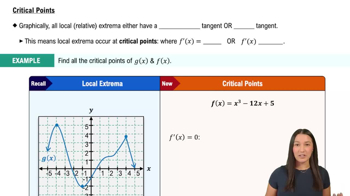
The derivative of a function, denoted as f', represents the rate of change of the function f. Critical points occur where the derivative is zero or undefined, indicating potential locations for horizontal tangent lines. In this context, finding the zeros of f' helps identify where the slope of f is zero, which corresponds to horizontal tangents.
Video consigliato:
04:50
Critical Points

Horizontal Tangent Lines

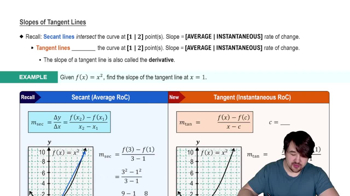
A horizontal tangent line occurs at points on the graph of a function where the slope is zero. This means that the derivative of the function at those points is equal to zero. Understanding this concept is crucial for verifying the relationship between the zeros of the derivative and the behavior of the original function.
Video consigliato:
Percorso guidato
05:13
Slopes of Tangent Lines

Graphing Functions

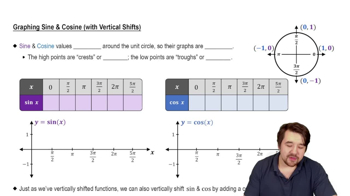
Graphing a function involves plotting its values on a coordinate plane to visualize its behavior. By graphing both f(x) and its derivative f'(x), one can observe how the zeros of f' correspond to points where f has horizontal tangents. This visual representation aids in understanding the relationship between a function and its derivative.
Video consigliato:
Percorso guidato
5:53
Graph of Sine and Cosine Function
Pratica correlata
Domanda del libro di testo

Tangents and inverses Suppose L(x)=ax+b (with a≠0) is the equation of the line tangent to the graph of a one-to-one function f at (x0,y0). Also, suppose M(x)=cx+d is the equation of the line tangent to the graph of f^−1 at (y0,x0).


c. Prove that L^−1(x)=M(x).

154
views
Domanda del libro di testo

{Use of Tech} Spring oscillations A spring hangs from the ceiling at equilibrium with a mass attached to its end. Suppose you pull downward on the mass and release it 10 inches below its equilibrium position with an upward push. The distance x (in inches) of the mass from its equilibrium position after t seconds is given by the function x(t) = 10sin t−10cos t, where x is positive when the mass is above the equilibrium position. <IMAGE>

c. At what times is the velocity of the mass zero?

283
views
Domanda del libro di testo

62–65. {Use of Tech} Graphing f and f'

c. Verify that the zeros of f' correspond to points at which f has a horizontal tangent line.

f(x)=e^−x tan^−1 x on [0,∞)

145
views
Domanda del libro di testo

City urbanization City planners model the size of their city using the function A(t) = - 1/50t² + 2t +20, for 0 ≤ t ≤ 50, where A is measured in square miles and t is the number of years after 2010.

c. Suppose the population density of the city remains constant from year to year at 1000 people mi². Determine the growth rate of the population in 2030.

297
views
Domanda del libro di testo

62–65. {Use of Tech} Graphing f and f'

c. Verify that the zeros of f' correspond to points at which f has a horizontal tangent line.

f(x) = (x−1) sin^−1 x on [−1,1]

243
views
Domanda del libro di testo

Witch of Agnesi Let y(x²+4)=8 (see figure). <IMAGE>

c. Solve the equation y(x²+4)=8 for y to find an explicit expression for y and then calculate dy/dx.

250
views