Ch. 3 - Derivatives
Briggs - Calculus: Early Transcendentals 3rd Edition
Briggs3rd EditionCalculus: Early TranscendentalsISBN: 9780136847243Non è quello che usi tu?Cambia libro di testo
Capitolo 3, Problema 3.10.65c

62–65. {Use of Tech} Graphing f and f'
c. Verify that the zeros of f' correspond to points at which f has a horizontal tangent line.
f(x)=e^−x tan^−1 x on [0,∞)

Guida verificata passo dopo passo
1
Step 1: Understand the problem. We need to graph the function f(x) = e^(-x) * tan^(-1)(x) and its derivative f'(x) over the interval [0, ∞). We will verify that the zeros of f'(x) correspond to points where f(x) has a horizontal tangent line.
Step 2: Find the derivative f'(x). Use the product rule for differentiation, which states that if you have a function h(x) = u(x) * v(x), then h'(x) = u'(x) * v(x) + u(x) * v'(x). Here, u(x) = e^(-x) and v(x) = tan^(-1)(x).
Step 3: Differentiate u(x) and v(x) separately. The derivative of u(x) = e^(-x) is u'(x) = -e^(-x). The derivative of v(x) = tan^(-1)(x) is v'(x) = 1/(1 + x^2).
Step 4: Apply the product rule. Substitute u(x), u'(x), v(x), and v'(x) into the product rule formula to find f'(x). This gives f'(x) = -e^(-x) * tan^(-1)(x) + e^(-x) * (1/(1 + x^2)).
Step 5: Graph f(x) and f'(x) using a graphing tool. Identify the zeros of f'(x) on the graph. These zeros are the x-values where f'(x) = 0, indicating that f(x) has a horizontal tangent line at these points. Verify that these correspond to the horizontal tangents on the graph of f(x).

Risposta video verificata per un problema simile:

Questa soluzione video è stata consigliata dai nostri tutor come utile per risolvere questo problema.
Durata del video:
7m

Concetti chiave

Ecco i concetti essenziali che devi comprendere per rispondere correttamente alla domanda.

Derivative and Critical Points

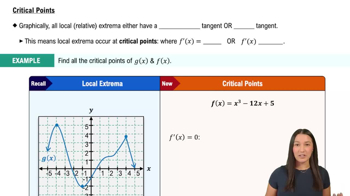
The derivative of a function, denoted as f', represents the rate of change of the function f. Critical points occur where the derivative is zero or undefined, indicating potential local maxima, minima, or points of inflection. In this context, finding the zeros of f' helps identify where the function f has horizontal tangent lines, which are essential for understanding the function's behavior.
Video consigliato:
04:50
Critical Points

Horizontal Tangent Lines

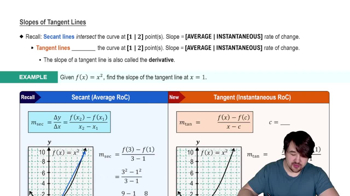
A horizontal tangent line occurs at points on the graph of a function where the slope is zero, meaning the derivative f' equals zero. This indicates that the function is neither increasing nor decreasing at that point, which is crucial for identifying local extrema. Verifying that the zeros of f' correspond to horizontal tangents helps confirm the relationship between the derivative and the function's graphical behavior.
Video consigliato:
Percorso guidato
05:13
Slopes of Tangent Lines

Graphing Functions

Graphing a function involves plotting its values on a coordinate system to visualize its behavior. For the function f(x) = e^(-x) tan^(-1)(x), understanding its graph helps in analyzing its critical points and the nature of its tangent lines. Technology can assist in graphing to easily identify where the function has horizontal tangents, enhancing comprehension of the relationship between f and f'.
Video consigliato:
Percorso guidato
5:53
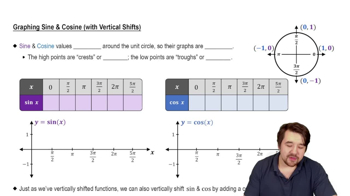
Graph of Sine and Cosine Function