
Ch. 3 - Derivatives
Briggs - Calculus: Early Transcendentals 3rd Edition
Briggs3rd EditionCalculus: Early TranscendentalsISBN: 9780136847243Non è quello che usi tu?Cambia libro di testo
Capitolo 3, Problema 3.6.23b

Throwing a stone Suppose a stone is thrown vertically upward from the edge of a cliff on Earth with an initial velocity of 32 ft/s from a height of 48 ft above the ground. The height (in feet) of the stone above the ground t seconds after it is thrown is s(t) = -16t²+32t+48.
b. When does the stone reach its highest point?

Guida verificata passo dopo passo
1
To find when the stone reaches its highest point, we need to determine the vertex of the quadratic function s(t) = -16t² + 32t + 48. The vertex of a parabola given by ax² + bx + c is found at t = -b/(2a).
Identify the coefficients from the quadratic equation: a = -16, b = 32, and c = 48.
Substitute the values of a and b into the vertex formula: t = -b/(2a). This gives t = -32/(2 * -16).
Simplify the expression to find the value of t. This will give you the time at which the stone reaches its highest point.
Once you have the value of t, you can verify by substituting it back into the original equation s(t) to find the height at this time, ensuring it is indeed the maximum height.

Risposta video verificata per un problema simile:

Questa soluzione video è stata consigliata dai nostri tutor come utile per risolvere questo problema.
Durata del video:
4m

Concetti chiave

Ecco i concetti essenziali che devi comprendere per rispondere correttamente alla domanda.

Quadratic Functions

The height of the stone is modeled by a quadratic function, which is a polynomial of degree two. In this case, the function s(t) = -16t² + 32t + 48 represents a parabola that opens downward due to the negative coefficient of the t² term. Understanding the properties of quadratic functions, such as their vertex and axis of symmetry, is essential for determining the maximum height of the stone.
Video consigliato:
6:04
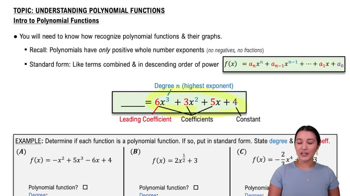
Introduction to Polynomial Functions

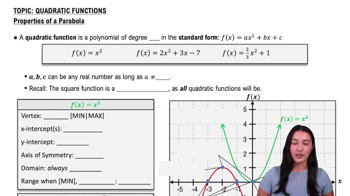
Vertex of a Parabola

The highest point of a downward-opening parabola, like the one representing the stone's height, is called the vertex. The vertex can be found using the formula t = -b/(2a), where a and b are the coefficients from the quadratic equation. This point corresponds to the time at which the stone reaches its maximum height, which is crucial for solving the problem.
Video consigliato:
7:42
Properties of Parabolas

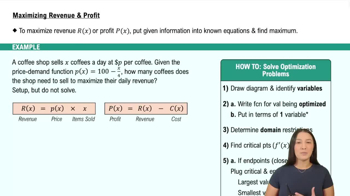
Maximizing Functions

Maximizing a function involves finding the input value that yields the highest output. In the context of the stone's height, this means determining the time at which the height function s(t) reaches its maximum value. This concept is fundamental in calculus, as it often involves taking the derivative of the function, setting it to zero, and solving for critical points to find maximum or minimum values.
Video consigliato:
04:18
Maximizing Profit & Revenue