Ch. 3 - Derivatives
Briggs - Calculus: Early Transcendentals 3rd Edition
Briggs3rd EditionCalculus: Early TranscendentalsISBN: 9780136847243Non è quello che usi tu?Cambia libro di testo
Capitolo 3, Problema 3.10.80b

Tracking a dive A biologist standing at the bottom of an 80-foot vertical cliff watches a peregrine falcon dive from the top of the cliff at a 45° angle from the horizontal (see figure). <IMAGE>


b. What is the rate of change of θ with respect to the bird’s height when it is 60 ft above the ground?

Guida verificata passo dopo passo
1
Identify the variables involved: Let θ be the angle of the falcon's dive with respect to the horizontal, and h be the height of the falcon above the ground.
Recognize the relationship between θ and h: Since the falcon is diving at a 45° angle, we can use trigonometric relationships. Specifically, tan(θ) = (80 - h) / x, where x is the horizontal distance from the base of the cliff to the falcon.
Differentiate the relationship with respect to time t: Use implicit differentiation on both sides of the equation tan(θ) = (80 - h) / x to find dθ/dt in terms of dh/dt and dx/dt.
Apply the chain rule: Differentiate tan(θ) with respect to t to get sec²(θ) * (dθ/dt) = (dx/dt * (80 - h) - x * dh/dt) / x².
Substitute known values: When the falcon is 60 ft above the ground, h = 60. Use the given angle and any additional information about the falcon's speed or horizontal distance to solve for dθ/dt.

Risposta video verificata per un problema simile:

Questa soluzione video è stata consigliata dai nostri tutor come utile per risolvere questo problema.
Durata del video:
11m

Concetti chiave

Ecco i concetti essenziali che devi comprendere per rispondere correttamente alla domanda.

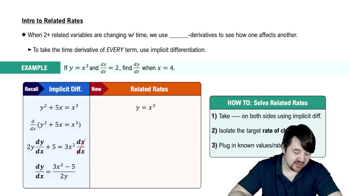
Related Rates

Related rates involve finding the rate at which one quantity changes in relation to another. In this problem, we need to determine how the angle θ changes as the height of the falcon changes. This concept is essential for solving problems where multiple variables are interdependent and change over time.
Video consigliato:
Percorso guidato
04:16
Intro To Related Rates

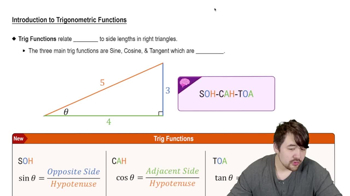
Trigonometric Functions

Trigonometric functions, such as sine, cosine, and tangent, relate the angles of a triangle to the lengths of its sides. In this scenario, the angle θ is related to the height of the falcon and the horizontal distance from the cliff. Understanding these functions is crucial for establishing the relationship between the angle and the height.
Video consigliato:
Percorso guidato
6:04
Introduction to Trigonometric Functions

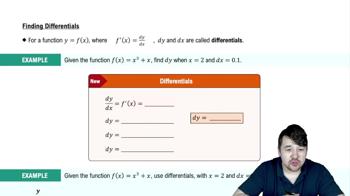
Differentiation

Differentiation is a fundamental concept in calculus that involves finding the derivative of a function, which represents the rate of change of that function. To find the rate of change of θ with respect to the bird's height, we will need to apply differentiation to the relationship established by the trigonometric functions, allowing us to compute how quickly the angle changes as the falcon descends.
Video consigliato:
Percorso guidato
05:53
Finding Differentials
Pratica correlata
Domanda del libro di testo

60–62. {Use of Tech} Multiple tangent lines Complete the following steps. <IMAGE>

b. Graph the tangent lines on the given graph.

x+y³−y=1; x=1

170
views

Domanda del libro di testo

{Use of Tech} A mixing tank A 500-liter (L) tank is filled with pure water. At time t=0, a salt solution begins flowing into the tank at a rate of 5 L/min. At the same time, the (fully mixed) solution flows out of the tank at a rate of 5.5 L/min. The mass of salt in grams in the tank at any time t≥0 is given by M(t) = 250(1000−t)(1−10−³⁰(1000−t)¹⁰) and the volume of solution in the tank is given by V(t) = 500-0.5t.

b. Graph the volume function and verify that the tank is empty when t=1000 min. 

275
views
Domanda del libro di testo

13-26 Implicit differentiation Carry out the following steps.

b. Find the slope of the curve at the given point.

x = e^y; (2, ln 2)

189
views
Domanda del libro di testo

62–65. {Use of Tech} Graphing f and f'

b. Compute and graph f'.

f(x)=e^−x tan^−1 x on [0,∞)

158
views
Domanda del libro di testo

Throwing a stone Suppose a stone is thrown vertically upward from the edge of a cliff on Earth with an initial velocity of 32 ft/s from a height of 48 ft above the ground. The height (in feet) of the stone above the ground t seconds after it is thrown is s(t) = -16t²+32t+48.

b. When does the stone reach its highest point?

184
views
Domanda del libro di testo

Product Rule for three functions Assume f, g, and h are differentiable at x.

b. Use the formula in (a) to find d/dx(e^x(x−1)(x+3))

418
views