Ch. 4 - Applications of the Derivative
Briggs - Calculus: Early Transcendentals 3rd Edition
Briggs3rd EditionCalculus: Early TranscendentalsISBN: 9780136847243Non è quello che usi tu?Cambia libro di testo
Capitolo 4, Problema 4.R.99

90–103. Indefinite integrals Determine the following indefinite integrals.


∫ (12/x)dx

Guida verificata passo dopo passo
1
Step 1: Recognize that the integral ∫ (12/x) dx involves a basic logarithmic rule. Recall that the integral of 1/x with respect to x is ln|x|.
Step 2: Factor out the constant 12 from the integral. This simplifies the expression to 12 ∫ (1/x) dx.
Step 3: Apply the logarithmic integration rule. The integral of 1/x dx is ln|x|, so the expression becomes 12 ln|x|.
Step 4: Add the constant of integration, C, to account for the indefinite nature of the integral. The result is 12 ln|x| + C.
Step 5: Verify the result by differentiating 12 ln|x| + C. The derivative of ln|x| is 1/x, and multiplying by 12 gives back the original integrand, confirming the solution.

Risposta video verificata per un problema simile:

Questa soluzione video è stata consigliata dai nostri tutor come utile per risolvere questo problema.
Durata del video:
56s

Concetti chiave

Ecco i concetti essenziali che devi comprendere per rispondere correttamente alla domanda.

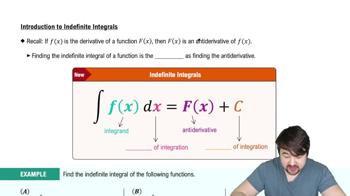
Indefinite Integral

An indefinite integral represents a family of functions whose derivative is the integrand. It is expressed without specific limits and includes a constant of integration, typically denoted as 'C'. The process of finding an indefinite integral is often referred to as antiderivation.
Video consigliato:
Percorso guidato
05:04
Introduction to Indefinite Integrals

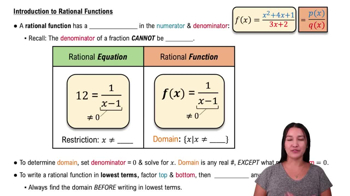
Integration of Rational Functions

Rational functions are ratios of polynomials. To integrate a rational function, one often uses techniques such as substitution or partial fraction decomposition. In the case of the integral ∫ (12/x)dx, recognizing that this is a simple rational function allows for straightforward integration using the natural logarithm.
Video consigliato:
6:04
Intro to Rational Functions

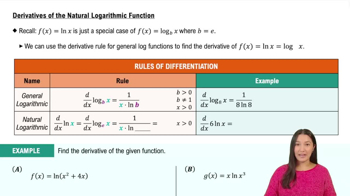
Natural Logarithm

The natural logarithm, denoted as ln(x), is the logarithm to the base 'e', where 'e' is approximately 2.71828. It is particularly important in calculus because the derivative of ln(x) is 1/x, making it a key function when integrating expressions involving 1/x, such as in the integral ∫ (12/x)dx.
Video consigliato:
05:18
Derivative of the Natural Logarithmic Function