Ch. 4 - Applications of the Derivative
Briggs - Calculus: Early Transcendentals 3rd Edition
Briggs3rd EditionCalculus: Early TranscendentalsISBN: 9780136847243Non è quello che usi tu?Cambia libro di testo
Capitolo 4, Problema 4.R.95

90–103. Indefinite integrals Determine the following indefinite integrals.


∫(1 + 3 cosΘ) dΘ

Guida verificata passo dopo passo
1
Step 1: Recognize that the integral is in the form ∫(1 + 3 cosΘ) dΘ, which can be split into two separate integrals: ∫1 dΘ + ∫3 cosΘ dΘ.
Step 2: Solve the first integral ∫1 dΘ. The integral of 1 with respect to Θ is simply Θ, because the derivative of Θ is 1.
Step 3: Solve the second integral ∫3 cosΘ dΘ. Use the constant multiple rule, which allows you to factor out the constant 3, resulting in 3∫cosΘ dΘ.
Step 4: Recall the integral of cosΘ with respect to Θ is sinΘ. Therefore, ∫cosΘ dΘ = sinΘ, and 3∫cosΘ dΘ = 3sinΘ.
Step 5: Combine the results from Step 2 and Step 4. The indefinite integral ∫(1 + 3 cosΘ) dΘ is Θ + 3sinΘ + C, where C is the constant of integration.

Risposta video verificata per un problema simile:

Questa soluzione video è stata consigliata dai nostri tutor come utile per risolvere questo problema.
Durata del video:
1m

Concetti chiave

Ecco i concetti essenziali che devi comprendere per rispondere correttamente alla domanda.

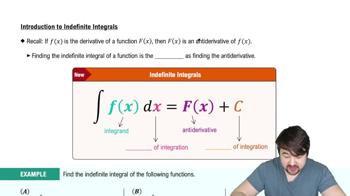
Indefinite Integral

An indefinite integral represents a family of functions whose derivative is the integrand. It is expressed without limits of integration and includes a constant of integration, typically denoted as 'C'. The process of finding an indefinite integral is often referred to as antidifferentiation.
Video consigliato:
Percorso guidato
05:04
Introduction to Indefinite Integrals

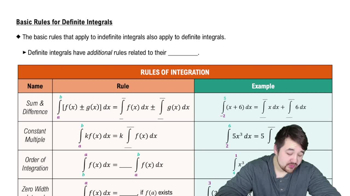
Basic Integration Rules

Basic integration rules are fundamental formulas used to compute integrals. For example, the integral of a constant 'a' is 'aΘ', and the integral of cos(Θ) is sin(Θ). Understanding these rules is essential for solving integrals efficiently and accurately.
Video consigliato:
Percorso guidato
06:07
Basic Rules for Definite Integrals

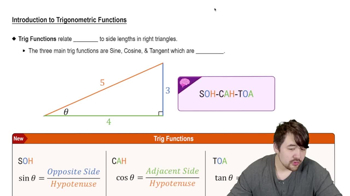
Trigonometric Functions

Trigonometric functions, such as sine and cosine, are periodic functions that arise in various mathematical contexts, including calculus. Their properties, such as periodicity and symmetry, play a crucial role in integration, especially when dealing with integrals involving trigonometric expressions.
Video consigliato:
Percorso guidato
6:04
Introduction to Trigonometric Functions