Ch. 4 - Applications of the Derivative
Briggs - Calculus: Early Transcendentals 3rd Edition
Briggs3rd EditionCalculus: Early TranscendentalsISBN: 9780136847243Non è quello che usi tu?Cambia libro di testo
Capitolo 4, Problema 4.6.59

Approximating changes


Approximate the change in the lateral surface area (excluding the area of the base) of a right circular cone of fixed height h = 6m when its radius decreases from r = 10 m to r = 9.9 m (S = πr√(r² + h²).

Guida verificata passo dopo passo
1
Identify the formula for the lateral surface area of a right circular cone, which is given by \( S = \pi r \sqrt{r^2 + h^2} \). Here, \( h = 6 \) meters is constant.
To approximate the change in the lateral surface area, use the concept of differentials. The differential \( dS \) can be expressed as \( dS = \frac{\partial S}{\partial r} \cdot dr \), where \( dr \) is the change in radius.
Calculate the partial derivative of \( S \) with respect to \( r \). This involves using the product rule and chain rule: \( \frac{\partial S}{\partial r} = \pi \sqrt{r^2 + h^2} + \pi r \cdot \frac{r}{\sqrt{r^2 + h^2}} \).
Simplify the expression for \( \frac{\partial S}{\partial r} \) to get \( \frac{\partial S}{\partial r} = \pi \left( \sqrt{r^2 + h^2} + \frac{r^2}{\sqrt{r^2 + h^2}} \right) \).
Substitute \( r = 10 \) m and \( dr = -0.1 \) m into the expression for \( dS \) to approximate the change in the lateral surface area: \( dS = \frac{\partial S}{\partial r} \bigg|_{r=10} \cdot (-0.1) \).

Risposta video verificata per un problema simile:

Questa soluzione video è stata consigliata dai nostri tutor come utile per risolvere questo problema.
Durata del video:
2m

Concetti chiave

Ecco i concetti essenziali che devi comprendere per rispondere correttamente alla domanda.

Differential Calculus

Differential calculus focuses on the concept of the derivative, which measures how a function changes as its input changes. In this context, it helps us approximate the change in the lateral surface area of the cone as the radius changes slightly. By using derivatives, we can find the rate of change of the surface area with respect to the radius.
Video consigliato:
Percorso guidato
06:11
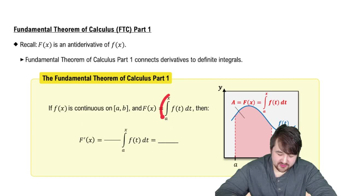
Fundamental Theorem of Calculus Part 1

Surface Area of a Cone

The lateral surface area of a right circular cone is given by the formula S = πr√(r² + h²), where r is the radius and h is the height. Understanding this formula is crucial for calculating the surface area before and after the change in radius. It highlights the relationship between the radius and the surface area, which is essential for applying calculus concepts.
Video consigliato:
09:07
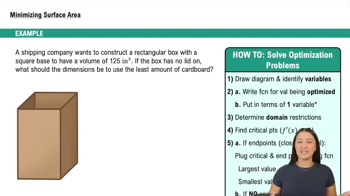
Example 1: Minimizing Surface Area

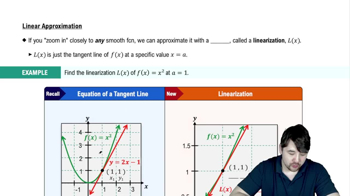
Linear Approximation

Linear approximation is a method used to estimate the value of a function near a given point using the tangent line at that point. In this problem, we can use the derivative of the surface area function to approximate the change in surface area when the radius decreases slightly from 10 m to 9.9 m. This technique simplifies complex calculations by providing a close estimate.
Video consigliato: