Ch. 4 - Applications of the Derivative
Briggs - Calculus: Early Transcendentals 3rd Edition
Briggs3rd EditionCalculus: Early TranscendentalsISBN: 9780136847243Non è quello che usi tu?Cambia libro di testo
Capitolo 4, Problema 4.6.13

Estimating speed Use the linear approximation given in Example 1 to answer the following questions.


If you travel one mile in 59 seconds, what is your approximate average speed? What is your exact speed?

Guida verificata passo dopo passo
1
To estimate the speed, we can use the concept of linear approximation. Linear approximation is a method of estimating the value of a function near a given point using the tangent line at that point.
First, identify the function that relates distance and time. The speed is the derivative of the distance with respect to time. If we denote distance as \( s(t) \) and time as \( t \), then speed \( v(t) \) is given by \( v(t) = \frac{ds}{dt} \).
Given that you travel one mile in 59 seconds, we can set up the function \( s(t) = t \) where \( s(t) \) is in miles and \( t \) is in seconds. The derivative \( \frac{ds}{dt} = 1 \) mile per second.
To find the approximate average speed, convert the time from seconds to hours since speed is typically measured in miles per hour. There are 3600 seconds in an hour, so the time in hours is \( \frac{59}{3600} \) hours.
Finally, calculate the approximate average speed using the formula \( \text{Speed} = \frac{\text{Distance}}{\text{Time}} \). Substitute the values: \( \text{Speed} = \frac{1 \text{ mile}}{\frac{59}{3600} \text{ hours}} \). This will give you the approximate average speed in miles per hour. For the exact speed, use the same formula without approximation.

Risposta video verificata per un problema simile:

Questa soluzione video è stata consigliata dai nostri tutor come utile per risolvere questo problema.
Durata del video:
2m

Concetti chiave

Ecco i concetti essenziali che devi comprendere per rispondere correttamente alla domanda.

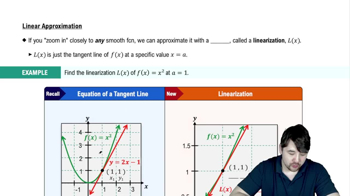
Linear Approximation

Linear approximation is a method used to estimate the value of a function near a given point using the tangent line at that point. It relies on the idea that for small changes in the input, the function can be approximated by a linear function. This is particularly useful in calculus for estimating values without needing to compute them exactly.
Video consigliato:

Average Speed

Average speed is defined as the total distance traveled divided by the total time taken. It provides a measure of how fast an object is moving over a specific interval. In this context, if you travel one mile in 59 seconds, the average speed can be calculated by converting the distance and time into consistent units, typically miles per hour.
Video consigliato:
Percorso guidato
06:37
Average Value of a Function

Exact Speed

Exact speed refers to the precise measurement of speed at a specific moment or over a specific distance and time. In contrast to average speed, which considers total distance and time, exact speed can be determined using calculus concepts such as derivatives, which provide instantaneous rates of change. This allows for a more accurate representation of speed at any given point.
Video consigliato:
Percorso guidato
06:29
Derivatives Applied To Velocity