Ch. 4 - Applications of the Derivative
Briggs - Calculus: Early Transcendentals 3rd Edition
Briggs3rd EditionCalculus: Early TranscendentalsISBN: 9780136847243Non è quello che usi tu?Cambia libro di testo
Capitolo 4, Problema 4.8.43

{Use of Tech} Newton’s method and curve sketching Use Newton’s method to find approximate answers to the following questions.
Where is the first local minimum of f(x) = (cos x)/x on the interval (0,∞) located?

Guida verificata passo dopo passo
1
Step 1: Understand Newton's Method. Newton's method is an iterative numerical technique used to find approximate roots of a real-valued function. The formula for Newton's method is: xn+1=xn-f(xn)f'(xn).
Step 2: Find the derivative of the function f(x) = (cos x)/x. Use the quotient rule for derivatives, which states: (uv)'=u'v-uv'v2, where u = cos x and v = x.
Step 3: Apply the quotient rule to find f'(x). Calculate u' = -sin x and v' = 1, then substitute into the quotient rule formula: f'(x)=(-sinx)x-cosx(1)x2.
Step 4: Choose an initial guess x₀ for the location of the first local minimum. Since the function is defined on the interval (0,∞), a reasonable starting point might be slightly greater than 0, such as x₀ = 0.1.
Step 5: Implement Newton's method iteratively using the formula from Step 1. Substitute f(x) and f'(x) into the formula, and update xₙ until the change between iterations is sufficiently small, indicating convergence to the local minimum.

Risposta video verificata per un problema simile:

Questa soluzione video è stata consigliata dai nostri tutor come utile per risolvere questo problema.
Durata del video:
8m

Concetti chiave

Ecco i concetti essenziali che devi comprendere per rispondere correttamente alla domanda.

Newton's Method

Newton's Method is an iterative numerical technique used to find approximate solutions to equations. It starts with an initial guess and refines it using the formula x_{n+1} = x_n - f(x_n)/f'(x_n), where f is the function and f' is its derivative. This method is particularly useful for finding roots of functions, and it converges quickly under suitable conditions.
Video consigliato:
Percorso guidato
4:26
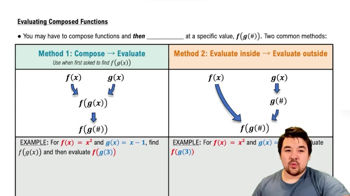
Evaluating Composed Functions

Local Minimum

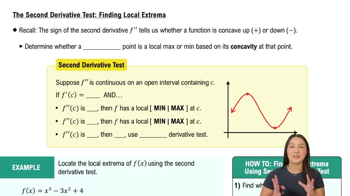
A local minimum of a function is a point where the function value is lower than that of its immediate neighbors. Mathematically, this occurs where the first derivative of the function is zero (f'(x) = 0) and the second derivative is positive (f''(x) > 0). Identifying local minima is crucial in optimization problems and helps in understanding the behavior of functions.
Video consigliato:
06:02
The Second Derivative Test: Finding Local Extrema

Curve Sketching

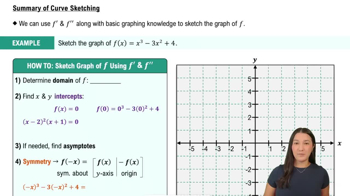
Curve sketching involves analyzing a function's behavior to create a visual representation of its graph. This includes determining key features such as intercepts, asymptotes, intervals of increase and decrease, and local extrema. By studying the first and second derivatives, one can gain insights into the function's shape and critical points, aiding in the overall understanding of its properties.
Video consigliato:
11:41
Summary of Curve Sketching