Ch. 4 - Applications of the Derivative
Briggs - Calculus: Early Transcendentals 3rd Edition
Briggs3rd EditionCalculus: Early TranscendentalsISBN: 9780136847243Non è quello che usi tu?Cambia libro di testo
Capitolo 4, Problema 4.R.16

Find the critical points of the following functions on the given intervals. Identify the absolute maximum and absolute minimum values (if they exist).
g(x) = x sin⁻¹ x on [-1, 1]

Guida verificata passo dopo passo
1
First, understand that critical points occur where the derivative of the function is zero or undefined. We need to find the derivative of g(x) = x sin⁻¹ x.
To find the derivative, apply the product rule: if u(x) = x and v(x) = sin⁻¹ x, then g'(x) = u'(x)v(x) + u(x)v'(x).
Calculate u'(x) = 1 and v'(x) = 1/√(1-x²) using the derivative of sin⁻¹ x. Substitute these into the product rule formula to get g'(x) = sin⁻¹ x + x/√(1-x²).
Set g'(x) = 0 to find critical points: sin⁻¹ x + x/√(1-x²) = 0. Solve this equation for x within the interval [-1, 1].
Evaluate g(x) at the critical points and endpoints of the interval [-1, 1] to determine the absolute maximum and minimum values. Compare these values to identify the absolute extrema.

Risposta video verificata per un problema simile:

Questa soluzione video è stata consigliata dai nostri tutor come utile per risolvere questo problema.
Durata del video:
4m

Concetti chiave

Ecco i concetti essenziali che devi comprendere per rispondere correttamente alla domanda.

Critical Points

Critical points of a function occur where its derivative is either zero or undefined. These points are essential for identifying local maxima and minima, as they represent potential locations where the function's behavior changes. To find critical points, one must first compute the derivative of the function and solve for the values of x that satisfy these conditions.
Video consigliato:
04:50
Critical Points

Absolute Maximum and Minimum

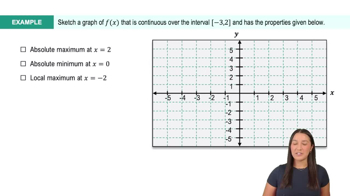
The absolute maximum and minimum values of a function on a closed interval are the highest and lowest values the function attains within that interval, including at the endpoints. To determine these values, one must evaluate the function at its critical points and at the endpoints of the interval. The largest and smallest of these values will be the absolute maximum and minimum, respectively.
Video consigliato:
03:22
Finding Extrema Graphically Example 4

Inverse Sine Function

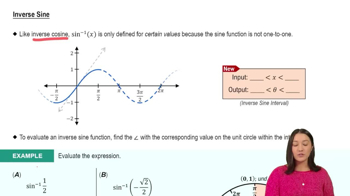
The inverse sine function, denoted as sin⁻¹(x) or arcsin(x), is the function that returns the angle whose sine is x. It is defined for x in the range [-1, 1] and outputs angles in the range [-π/2, π/2]. Understanding the properties of the inverse sine function is crucial when analyzing the function g(x) = x sin⁻¹(x), as it affects the behavior and differentiability of g(x) within the specified interval.
Video consigliato:
4:03
Inverse Sine