Ch. 4 - Applications of the Derivative
Briggs - Calculus: Early Transcendentals 3rd Edition
Briggs3rd EditionCalculus: Early TranscendentalsISBN: 9780136847243Non è quello che usi tu?Cambia libro di testo
Capitolo 4, Problema 4.R.118a

{Use of Tech} A family of superexponential functions Let ƒ(x) = (a + x)ˣ , where a > 0.


a. What is the domain of f (in terms of a)?

Guida verificata passo dopo passo
1
To determine the domain of the function \( f(x) = (a + x)^x \), we need to identify the values of \( x \) for which the expression is defined.
The expression \( (a + x)^x \) is defined when \( a + x > 0 \) because the base of the power must be positive for real number exponents.
Solve the inequality \( a + x > 0 \) to find the values of \( x \). This gives \( x > -a \).
Therefore, the domain of \( f(x) \) in terms of \( a \) is all real numbers \( x \) such that \( x > -a \).
In interval notation, the domain is \( (-a, \infty) \).

Risposta video verificata per un problema simile:

Questa soluzione video è stata consigliata dai nostri tutor come utile per risolvere questo problema.
Durata del video:
1m

Concetti chiave

Ecco i concetti essenziali che devi comprendere per rispondere correttamente alla domanda.

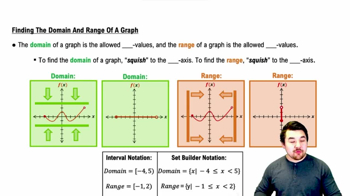
Domain of a Function

The domain of a function refers to the set of all possible input values (x-values) for which the function is defined. For the function f(x) = (a + x)ˣ, where a > 0, the domain is determined by the values of x that keep the expression a + x positive, as the base of an exponent must be positive for real-valued outputs.
Video consigliato:
Percorso guidato
5:10
Finding the Domain and Range of a Graph

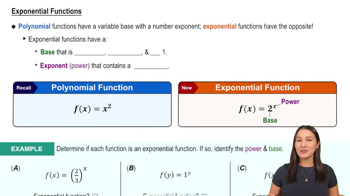
Exponential Functions

Exponential functions are mathematical expressions in the form f(x) = bˣ, where b is a positive constant. In the case of f(x) = (a + x)ˣ, the function exhibits superexponential growth, meaning it grows faster than any polynomial function as x increases. Understanding the behavior of exponential functions is crucial for analyzing their domains and ranges.
Video consigliato:
6:13
Exponential Functions

Inequalities

Inequalities are mathematical statements that compare two expressions, indicating whether one is greater than, less than, or equal to the other. In determining the domain of f(x) = (a + x)ˣ, we need to solve the inequality a + x > 0, which leads to x > -a. This understanding of inequalities is essential for identifying valid input values for the function.
Video consigliato:
Percorso guidato
5:10
Finding the Domain and Range of a Graph