Ch. 4 - Applications of the Derivative
Briggs - Calculus: Early Transcendentals 3rd Edition
Briggs3rd EditionCalculus: Early TranscendentalsISBN: 9780136847243Non è quello che usi tu?Cambia libro di testo
Capitolo 4, Problema 4.3.80

Second Derivative Test Locate the critical points of the following functions. Then use the Second Derivative Test to determine (if possible) whether they correspond to local maxima or local minima.


f(x) = x³ - (3/2)x² - 36x

Guida verificata passo dopo passo
1
First, find the first derivative of the function f(x) = x³ - (3/2)x² - 36x. The first derivative, f'(x), is obtained by differentiating each term: f'(x) = 3x² - 3x - 36.
Next, locate the critical points by setting the first derivative equal to zero and solving for x: 3x² - 3x - 36 = 0. This is a quadratic equation, which can be solved using factoring, the quadratic formula, or completing the square.
Once the critical points are found, calculate the second derivative of the function, f''(x), by differentiating the first derivative: f''(x) = 6x - 3.
Apply the Second Derivative Test to each critical point. Substitute each critical point into the second derivative, f''(x). If f''(x) > 0 at a critical point, the function has a local minimum there. If f''(x) < 0, the function has a local maximum. If f''(x) = 0, the test is inconclusive.
Interpret the results from the Second Derivative Test to determine the nature of each critical point, whether it corresponds to a local maximum, local minimum, or if the test is inconclusive.

Risposta video verificata per un problema simile:

Questa soluzione video è stata consigliata dai nostri tutor come utile per risolvere questo problema.
Durata del video:
4m

Concetti chiave

Ecco i concetti essenziali che devi comprendere per rispondere correttamente alla domanda.

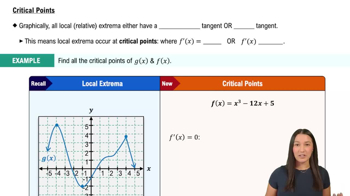
Critical Points

Critical points of a function occur where its first derivative is zero or undefined. These points are essential for identifying potential local maxima and minima, as they represent locations where the function's slope changes. To find critical points, one must differentiate the function and solve for the values of x that satisfy the condition f'(x) = 0.
Video consigliato:
04:50
Critical Points

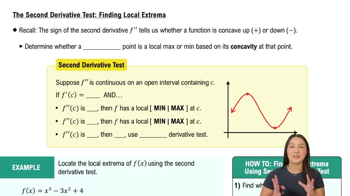
Second Derivative Test

The Second Derivative Test is a method used to classify critical points as local maxima, local minima, or saddle points. It involves evaluating the second derivative of the function at the critical points. If f''(x) > 0, the point is a local minimum; if f''(x) < 0, it is a local maximum; and if f''(x) = 0, the test is inconclusive.
Video consigliato:
06:02
The Second Derivative Test: Finding Local Extrema

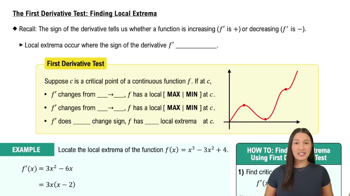
Local Maxima and Minima

Local maxima and minima refer to the highest and lowest points in a specific neighborhood of a function's graph. A local maximum is a point where the function value is greater than that of nearby points, while a local minimum is where it is lower. Understanding these concepts is crucial for analyzing the behavior of functions and optimizing values in various applications.
Video consigliato:
07:09
The First Derivative Test: Finding Local Extrema