
Ch. 4 - Applications of the Derivative
Briggs - Calculus: Early Transcendentals 3rd Edition
Briggs3rd EditionCalculus: Early TranscendentalsISBN: 9780136847243Non è quello che usi tu?Cambia libro di testo
Capitolo 4, Problema 4.5.68

Cylinder and cones (Putnam Exam 1938) Right circular cones of height h and radius r are attached to each end of a right circular cylinder of height h and radius r, forming a double-pointed object. For a given surface area A, what are the dimensions r and h that maximize the volume of the object?

Guida verificata passo dopo passo
1
First, understand the problem: We have a double-pointed object consisting of a cylinder and two cones. We need to find the dimensions (radius r and height h) that maximize the volume given a fixed surface area A.
Calculate the surface area of the object: The surface area includes the lateral surface area of the cylinder and the lateral surface areas of the two cones. The formula for the surface area of the cylinder is 2πrh, and for each cone, it is πr√(r² + h²). Therefore, the total surface area is A = 2πrh + 2πr√(r² + h²).
Calculate the volume of the object: The volume includes the volume of the cylinder and the volumes of the two cones. The formula for the volume of the cylinder is πr²h, and for each cone, it is (1/3)πr²h. Therefore, the total volume is V = πr²h + 2(1/3)πr²h = (5/3)πr²h.
Set up the optimization problem: We need to maximize the volume V = (5/3)πr²h subject to the constraint that the surface area A = 2πrh + 2πr√(r² + h²) is constant. Use the method of Lagrange multipliers to solve this constrained optimization problem.
Solve the system of equations obtained from the Lagrange multipliers: Differentiate the volume and surface area equations with respect to r and h, set up the Lagrange function, and solve the resulting equations to find the values of r and h that maximize the volume.

Risposta video verificata per un problema simile:

Questa soluzione video è stata consigliata dai nostri tutor come utile per risolvere questo problema.
Durata del video:
7m

Concetti chiave

Ecco i concetti essenziali che devi comprendere per rispondere correttamente alla domanda.

Surface Area and Volume Formulas

To solve the problem, one must understand the formulas for the surface area and volume of the geometric shapes involved: the cylinder and the cones. The surface area of the cylinder is given by 2πrh + 2πr², while the volume is V = πr²h for the cylinder and V = (1/3)πr²h for each cone. These formulas are essential for setting up the optimization problem.
Video consigliato:
09:07
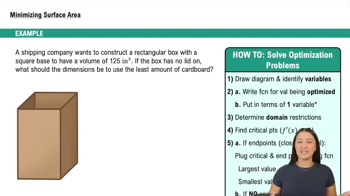
Example 1: Minimizing Surface Area

Optimization Techniques

Optimization involves finding the maximum or minimum values of a function. In this context, we need to maximize the volume of the double-pointed object while adhering to a fixed surface area. Techniques such as the method of Lagrange multipliers or substitution can be employed to find the optimal dimensions by setting up a function to maximize and applying calculus principles.
Video consigliato:
10:13
Intro to Applied Optimization: Maximizing Area

Calculus of Functions of Multiple Variables

The problem requires understanding how to work with functions of multiple variables, specifically the volume as a function of both radius r and height h. This involves partial derivatives to find critical points and determine maxima or minima, as well as constraints that arise from the fixed surface area. Mastery of these concepts is crucial for effectively solving the optimization problem.
Video consigliato:
Percorso guidato
06:11
Fundamental Theorem of Calculus Part 1