Ch. 5 - Integration
Briggs - Calculus: Early Transcendentals 3rd Edition
Briggs3rd EditionCalculus: Early TranscendentalsISBN: 9780136847243Non è quello che usi tu?Cambia libro di testo
Capitolo 5, Problema 5.2.25b

{Use of Tech} Approximating net area The following functions are positive and negative on the given interval.
ƒ(𝓍) = tan⁻¹ (3x - 1) on [0,1]
(b) Approximate the net area bounded by the graph of f and the x-axis on the interval using a left, right, and midpoint Riemann sum with n = 4.

Guida verificata passo dopo passo
1
Step 1: Understand the problem. You are tasked with approximating the net area bounded by the graph of ƒ(𝓍) = tan⁻¹(3x - 1) and the x-axis on the interval [0,1] using Riemann sums (left, right, and midpoint) with n = 4 subintervals.
Step 2: Divide the interval [0,1] into n = 4 subintervals. The width of each subinterval, Δx, is calculated as Δx = (1 - 0)/4 = 1/4.
Step 3: Determine the x-values for the left endpoints, right endpoints, and midpoints of the subintervals. For left endpoints: x₀ = 0, x₁ = 1/4, x₂ = 1/2, x₃ = 3/4. For right endpoints: x₁ = 1/4, x₂ = 1/2, x₃ = 3/4, x₄ = 1. For midpoints: x₀ = 1/8, x₁ = 3/8, x₂ = 5/8, x₃ = 7/8.
Step 4: Evaluate the function ƒ(𝓍) = tan⁻¹(3x - 1) at each of the x-values determined in Step 3. For example, for left endpoints, calculate ƒ(0), ƒ(1/4), ƒ(1/2), and ƒ(3/4). Repeat this for right endpoints and midpoints.
Step 5: Compute the Riemann sums. Multiply each function value by the width of the subinterval, Δx = 1/4, and sum them up. For the left Riemann sum: S_left = Δx * [ƒ(0) + ƒ(1/4) + ƒ(1/2) + ƒ(3/4)]. For the right Riemann sum: S_right = Δx * [ƒ(1/4) + ƒ(1/2) + ƒ(3/4) + ƒ(1)]. For the midpoint Riemann sum: S_mid = Δx * [ƒ(1/8) + ƒ(3/8) + ƒ(5/8) + ƒ(7/8)].

Risposta video verificata per un problema simile:

Questa soluzione video è stata consigliata dai nostri tutor come utile per risolvere questo problema.
Durata del video:
4m

Concetti chiave

Ecco i concetti essenziali che devi comprendere per rispondere correttamente alla domanda.

Riemann Sums

Riemann sums are a method for approximating the total area under a curve by dividing the interval into smaller subintervals. Each subinterval's area is estimated using the function's value at specific points, such as the left endpoint, right endpoint, or midpoint. The sum of these areas provides an approximation of the net area under the curve over the specified interval.
Video consigliato:
Percorso guidato
06:11
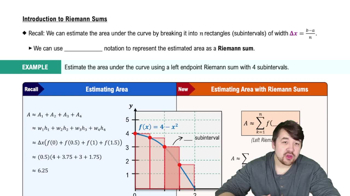
Introduction to Riemann Sums

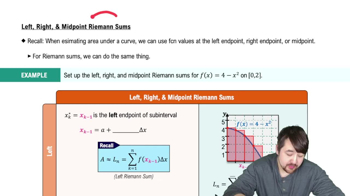
Left, Right, and Midpoint Sums

In Riemann sums, the left sum uses the function's value at the left endpoint of each subinterval, while the right sum uses the value at the right endpoint. The midpoint sum, on the other hand, takes the function's value at the midpoint of each subinterval. Each method yields different approximations of the area, with the midpoint sum often providing a more accurate estimate due to its consideration of the function's behavior within the interval.
Video consigliato:
Percorso guidato
07:39
Left, Right, & Midpoint Riemann Sums

Net Area

The net area refers to the total area between the graph of a function and the x-axis over a specified interval, accounting for both positive and negative areas. Positive areas are above the x-axis, while negative areas are below it. When calculating net area using Riemann sums, it is essential to consider the sign of the function's values to ensure that the total area reflects the correct contributions from both regions.
Video consigliato:
05:06
Finding Area When Bounds Are Not Given
Pratica correlata
Domanda del libro di testo

Sigma notation Evaluate the following expressions.                                                                                                                                          

(c)     4                                                                                                                                                                               

       ∑ κ²                                                                                                                                                                          

       κ=1                         

Domanda del libro di testo

Explain why or why not Determine whether the following statements are true and give an explanation or counterexample. Assume ƒ, ƒ', and ƒ'' are continuous functions for all real numbers.                                                                                                                                                           


(b) ∫ (ƒ(𝓍))ⁿ ƒ'(𝓍) d𝓍 = 1/(n + 1) (ƒ(𝓍))ⁿ⁺¹ + C , n ≠ ―1 .

45
views
Domanda del libro di testo

Using properties of integrals Use the value of the first integral I to evaluate the two given integrals. 

I = ∫₀^π/2 (cos θ ― 2 sin θ) dθ = ―1

(b) ∫₀^π/2 (4 cos θ ― 8 sin θ) dθ

77
views
Domanda del libro di testo

Explain why or why not Determine whether the following statements are true and give an explanation or counterexample.

(c) For an increasing or decreasing nonconstant function on an interval [a,b] and a given value of n, the value of the midpoint Riemann sum always lies between the values of the left and right Riemann sums.

63
views
Domanda del libro di testo

Matching functions with area functions Match the functions ƒ, whose graphs are given in a― d, with the area functions A (𝓍) = ∫₀ˣ ƒ(t) dt, whose graphs are given in A–D.


70
views
Domanda del libro di testo

Explain why or why not Determine whether the following statements are true and give an explanation or counterexample.                                                                          

                                                                                                                                                                                     (b) Suppose ƒ is a negative increasing function, for 𝓍 > 0 . Then the area function A(𝓍) = ∫₀ˣ ƒ(t) dt is a decreasing function of 𝓍 .

60
views