
Ch. 6 - Applications of Integration
Briggs - Calculus: Early Transcendentals 3rd Edition
Briggs3rd EditionCalculus: Early TranscendentalsISBN: 9780136847243Non è quello che usi tu?Cambia libro di testo
Capitolo 6, Problema 6.7.27a

Calculating work for different springs Calculate the work required to stretch the following springs 0.5m from their equilibrium positions. Assume Hooke’s law is obeyed.
a. A spring that requires a force of 50 N to be stretched 0.2 m from its equilibrium position

Guida verificata passo dopo passo
1
Identify the given information: the force required to stretch the spring 0.2 m is 50 N, and we want to find the work done to stretch it 0.5 m.
Recall Hooke's Law, which states that the force exerted by a spring is proportional to the displacement from equilibrium: \(F = k \times x\), where \(k\) is the spring constant and \(x\) is the displacement.
Use the given force and displacement to solve for the spring constant \(k\): rearrange Hooke's Law to \(k = \frac{F}{x}\), then substitute \(F = 50\) N and \(x = 0.2\) m.
Calculate the work done to stretch the spring from 0 to 0.5 m using the formula for work done on a spring: \(W = \frac{1}{2} k x^2\), where \(x\) is the final displacement (0.5 m).
Substitute the value of \(k\) found in step 3 and \(x = 0.5\) m into the work formula to express the work required to stretch the spring 0.5 m.

Risposta video verificata per un problema simile:

Questa soluzione video è stata consigliata dai nostri tutor come utile per risolvere questo problema.
Durata del video:
2m

Concetti chiave

Ecco i concetti essenziali che devi comprendere per rispondere correttamente alla domanda.

Hooke's Law

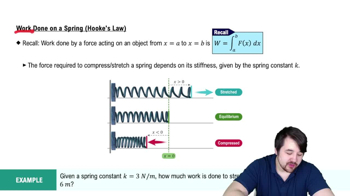
Hooke's Law states that the force needed to stretch or compress a spring is proportional to the displacement from its equilibrium position, expressed as F = kx, where k is the spring constant and x is the displacement. This linear relationship is fundamental for calculating forces in spring problems.
Video consigliato:
Percorso guidato
05:40
Work Done On A Spring (Hooke's Law)

Spring Constant (k)

The spring constant k measures the stiffness of a spring and is calculated by dividing the force applied by the displacement (k = F/x). Knowing k allows you to determine the force required for any displacement and is essential for computing the work done on the spring.
Video consigliato:
Percorso guidato
05:40
Work Done On A Spring (Hooke's Law)

Work Done on a Spring

The work done to stretch or compress a spring is the energy stored in it, calculated by the integral of force over displacement. For springs obeying Hooke’s Law, work is W = (1/2)kx², representing the area under the force-displacement curve, which is a triangle.
Video consigliato:
Percorso guidato
05:40
Work Done On A Spring (Hooke's Law)
Pratica correlata
Domanda del libro di testo

In the design of solid objects (both artificial and natural), the ratio of the surface area to the volume of the object is important. Animals typically generate heat at a rate proportional to their volume and lose heat at a rate proportional to their surface area. Therefore, animals with a low SAV ratio tend to retain heat, whereas animals with a high SAV ratio (such as children and hummingbirds) lose heat relatively quickly.


a. What is the SAV ratio of a cube with side lengths a?

55
views
Domanda del libro di testo

9–10. Velocity graphs The figures show velocity functions for motion along a line. Assume the motion begins with an initial position of s(0)=0. Determine the following.

a. The displacement between t=0 and t=5

50
views
Domanda del libro di testo

Consider a solid whose base is the region in the first quadrant bounded by the curve y=√3−x and the line x=2, and whose cross sections through the solid perpendicular to the x-axis are squares.


a. Find an expression for the area A(x) of a cross section of the solid at a point x in [0, 2].

100
views
Domanda del libro di testo

17–22. Position from velocity Consider an object moving along a line with the given velocity v and initial position.


a. Determine the position function, for t≥0, using the antiderivative method


v(t) = 9−t² on [0, 4]; s(0)=−2

72
views
Domanda del libro di testo

"Determine whether the following statements are true and give an explanation or counterexample.


a. A pyramid is a solid of revolution. "

71
views
Domanda del libro di testo

Find the area of the region (see figure) in two ways.

a. Using integration with respect to x.

93
views