
Ch. 6 - Applications of Integration
Briggs - Calculus: Early Transcendentals 3rd Edition
Briggs3rd EditionCalculus: Early TranscendentalsISBN: 9780136847243Non è quello che usi tu?Cambia libro di testo
Capitolo 6, Problema 6.3.61a

"Determine whether the following statements are true and give an explanation or counterexample.


a. A pyramid is a solid of revolution. "

Guida verificata passo dopo passo
1
Step 1: Understand the concept of a solid of revolution. A solid of revolution is a three-dimensional shape created by rotating a two-dimensional region around an axis. Common examples include spheres, cylinders, and cones.
Step 2: Analyze the geometry of a pyramid. A pyramid is a polyhedron with a polygonal base and triangular faces that converge at a single point (the apex). It is not formed by rotating a two-dimensional region around an axis.
Step 3: Compare the formation of a pyramid to the definition of a solid of revolution. Since a pyramid is constructed by connecting the base to the apex with straight edges, it does not involve any rotational symmetry or revolution around an axis.
Step 4: Conclude whether the statement is true or false. Based on the analysis, a pyramid is not a solid of revolution because its shape does not result from rotation.
Step 5: Provide a counterexample to clarify. For instance, a cone is a solid of revolution because it can be formed by rotating a right triangle around one of its legs, whereas a pyramid cannot be formed in this way.

Risposta video verificata per un problema simile:

Questa soluzione video è stata consigliata dai nostri tutor come utile per risolvere questo problema.
Durata del video:
1m

Concetti chiave

Ecco i concetti essenziali che devi comprendere per rispondere correttamente alla domanda.

Solid of Revolution

A solid of revolution is a three-dimensional shape created by rotating a two-dimensional shape around an axis. Common examples include spheres, cylinders, and cones, which are formed by rotating circles or triangles. Understanding this concept is crucial for distinguishing between solids of revolution and other types of solids.
Video consigliato:
04:48
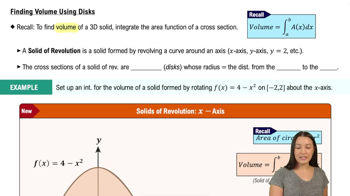
Finding Volume Using Disks

Pyramid

A pyramid is a polyhedron characterized by a polygonal base and triangular faces that converge at a single point called the apex. Unlike solids of revolution, pyramids do not arise from the rotation of a shape around an axis. Recognizing the geometric properties of pyramids helps clarify their classification in solid geometry.

Geometric Classification

Geometric classification involves categorizing shapes based on their properties and dimensions. This includes differentiating between solids of revolution, polyhedra, and other geometric forms. Understanding these classifications is essential for accurately assessing statements about geometric figures, such as whether a pyramid qualifies as a solid of revolution.
Video consigliato:
04:18
Geometric Sequences - Recursive Formula
Pratica correlata
Domanda del libro di testo

Calculating work for different springs Calculate the work required to stretch the following springs 0.5m from their equilibrium positions. Assume Hooke’s law is obeyed.

a. A spring that requires a force of 50 N to be stretched 0.2 m from its equilibrium position

52
views
Domanda del libro di testo

In the design of solid objects (both artificial and natural), the ratio of the surface area to the volume of the object is important. Animals typically generate heat at a rate proportional to their volume and lose heat at a rate proportional to their surface area. Therefore, animals with a low SAV ratio tend to retain heat, whereas animals with a high SAV ratio (such as children and hummingbirds) lose heat relatively quickly.


a. What is the SAV ratio of a cube with side lengths a?

55
views
Domanda del libro di testo

9–10. Velocity graphs The figures show velocity functions for motion along a line. Assume the motion begins with an initial position of s(0)=0. Determine the following.

a. The displacement between t=0 and t=5

50
views
Domanda del libro di testo

17–22. Position from velocity Consider an object moving along a line with the given velocity v and initial position.


a. Determine the position function, for t≥0, using the antiderivative method


v(t) = 9−t² on [0, 4]; s(0)=−2

72
views
Domanda del libro di testo

Critical depth A large tank has a plastic window on one wall that is designed to withstand a force of 90,000 N. The square window is 2 m on a side, and its lower edge is 1 m from the bottom of the tank.

a. If the tank is filled to a depth of 4 m, will the window withstand the resulting force?

56
views
Domanda del libro di testo

Mass of two bars Two bars of length L have densities ρ₁(x) = 4e^−x and ρ₂(x) = 6e^−2x, for 0≤x≤L.

a. For what values of L is bar 1 heavier than bar 2?

36
views