
Ch. 6 - Applications of Integration
Briggs - Calculus: Early Transcendentals 3rd Edition
Briggs3rd EditionCalculus: Early TranscendentalsISBN: 9780136847243Non è quello che usi tu?Cambia libro di testo
Capitolo 6, Problema 6.6.39a

In the design of solid objects (both artificial and natural), the ratio of the surface area to the volume of the object is important. Animals typically generate heat at a rate proportional to their volume and lose heat at a rate proportional to their surface area. Therefore, animals with a low SAV ratio tend to retain heat, whereas animals with a high SAV ratio (such as children and hummingbirds) lose heat relatively quickly.


a. What is the SAV ratio of a cube with side lengths a?

Guida verificata passo dopo passo
1
Recall the formulas for the surface area and volume of a cube. The surface area (SA) of a cube with side length \(a\) is given by $SA = 6a^{2}$ because a cube has 6 faces, each with area \(a^{2}\).
The volume (V) of the cube is given by \(V = a^{3}\) since volume is the product of the three side lengths, all equal to \(a\).
The surface area to volume (SAV) ratio is defined as the surface area divided by the volume, so write the ratio as \(\frac{SA}{V} = \frac{6a^{2}}{a^{3}}\).
Simplify the expression by dividing the powers of \(a\): \(\frac{6a^{2}}{a^{3}} = 6a^{2 - 3} = 6a^{-1}\).
Rewrite the simplified expression to a more standard form: \(6a^{-1} = \frac{6}{a}\). This is the SAV ratio of the cube in terms of its side length \(a\).

Risposta video verificata per un problema simile:

Questa soluzione video è stata consigliata dai nostri tutor come utile per risolvere questo problema.
Durata del video:
1m

Concetti chiave

Ecco i concetti essenziali che devi comprendere per rispondere correttamente alla domanda.

Surface Area and Volume of a Cube

A cube has six equal square faces, each with area a², so its total surface area is 6a². Its volume is the cube of its side length, a³. Understanding these formulas is essential to calculate the surface area to volume (SAV) ratio.
Video consigliato:
09:07
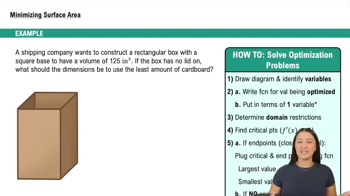
Example 1: Minimizing Surface Area

Surface Area to Volume (SAV) Ratio

The SAV ratio compares the surface area of an object to its volume, often expressed as surface area divided by volume. It is a key concept in biology and physics, influencing processes like heat loss, as surface area affects exchange rates while volume relates to internal content.
Video consigliato:
09:07
Example 1: Minimizing Surface Area

Proportional Relationships in Biological Contexts

In biology, heat generation is proportional to volume, while heat loss is proportional to surface area. This proportionality explains why smaller animals with higher SAV ratios lose heat faster, linking mathematical ratios to real-world biological phenomena.
Video consigliato:
03:30
The Power Rule: Negative & Rational Exponents Example 3