
Ch. 8 - Integration Techniques
Briggs - Calculus: Early Transcendentals 3rd Edition
Briggs3rd EditionCalculus: Early TranscendentalsISBN: 9780136847243Non è quello che usi tu?Cambia libro di testo
Capitolo 8, Problema 8.R.102

102–105. Volumes The region R is bounded by the curve y = ln(x) and the x-axis on the interval [1, e]. Find the volume of the solid generated when R is revolved in the following ways.
102. About the y-axis

Guida verificata passo dopo passo
1
Identify the region R bounded by the curve \(y = \ln(x)\) and the x-axis on the interval \([1, e]\). This means the region lies between \(x=1\) and \(x=e\), above the x-axis and below the curve \(y=\ln(x)\).
Since the solid is generated by revolving the region around the y-axis, consider using the method of cylindrical shells. The formula for the volume using shells is \(V = \int_a^b 2\pi \cdot (\text{radius}) \cdot (\text{height}) \, dx\).
In this problem, the radius of a shell is the distance from the y-axis to a point \(x\), which is simply \(x\). The height of the shell is the value of the function \(y = \ln(x)\).
Set up the integral for the volume as \(V = \int_1^e 2\pi x \ln(x) \, dx\). This integral represents the sum of the volumes of all cylindrical shells from \(x=1\) to \(x=e\).
To find the volume, evaluate the integral \(\int_1^e x \ln(x) \, dx\) using integration by parts, then multiply the result by \(2\pi\).

Risposta video verificata per un problema simile:

Questa soluzione video è stata consigliata dai nostri tutor come utile per risolvere questo problema.
Durata del video:
1m

Concetti chiave

Ecco i concetti essenziali che devi comprendere per rispondere correttamente alla domanda.

Volume of Solids of Revolution

This concept involves finding the volume of a 3D solid formed by rotating a 2D region around an axis. Common methods include the disk/washer method and the shell method, which use integration to sum infinitesimal volumes. Understanding which method to apply depends on the axis of rotation and the shape of the region.
Video consigliato:
04:48
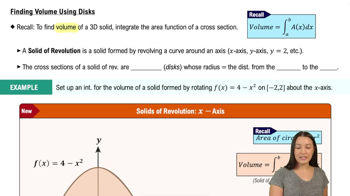
Finding Volume Using Disks

Shell Method

The shell method calculates volume by integrating cylindrical shells formed when a region is revolved around an axis. For rotation about the y-axis, vertical slices parallel to the axis create shells with radius equal to the x-value and height given by the function. The volume is found by integrating 2π(radius)(height) dx over the interval.
Video consigliato:
07:33
Euler's Method

Natural Logarithm Function and Its Properties

The function y = ln(x) is defined for x > 0 and is the inverse of the exponential function. It is continuous and increasing on [1, e], with ln(1) = 0 and ln(e) = 1. Understanding its behavior helps determine the region bounded by y = ln(x) and the x-axis, which is essential for setting up the integral limits and expressions.
Video consigliato:
Percorso guidato
06:21
Properties of Functions