

Ch. 8 - Integration Techniques
Briggs - Calculus: Early Transcendentals 3rd Edition
Briggs3rd EditionCalculus: Early TranscendentalsISBN: 9780136847243Non è quello che usi tu?Cambia libro di testo
Capitolo 8, Problema 8.R.125a

125. Wallis products Complete the following steps to prove a well-known formula discovered by the 17th-century English mathematician John Wallis.
a. Use a reduction formula to show that ∫ from 0 to π of (sin^m x) dx = (m − 1)/m × ∫ from 0 to π of (sin^(m−2) x) dx, for any integer m ≥ 2.

Guida verificata passo dopo passo
1
Step 1: Begin by recalling the reduction formula for integrals involving powers of trigonometric functions. The goal is to express the integral of sin^m(x) in terms of the integral of sin^(m−2)(x). Start with the integral I = ∫ from 0 to π of (sin^m(x)) dx.
Step 2: Use integration by parts to simplify the integral. Let u = sin^(m−1)(x) and dv = sin(x) dx. Then, compute du = (m−1)sin^(m−2)(x)cos(x) dx and v = −cos(x). Substitute these into the integration by parts formula: ∫ u dv = uv − ∫ v du.
Step 3: Evaluate the boundary terms uv at x = 0 and x = π. Note that sin(0) = sin(π) = 0, so the boundary terms vanish. This simplifies the integral to −∫ from 0 to π of (−cos(x) * (m−1)sin^(m−2)(x)cos(x)) dx.
Step 4: Simplify the remaining integral. Combine the cos^2(x) term and use the Pythagorean identity cos^2(x) = 1 − sin^2(x) to express the integral in terms of sin^(m−2)(x). This leads to a recursive relationship between the integrals of sin^m(x) and sin^(m−2)(x).
Step 5: Factor out constants and simplify the recursive formula to show that ∫ from 0 to π of (sin^m(x)) dx = (m−1)/m × ∫ from 0 to π of (sin^(m−2)(x)) dx. This completes the proof of the reduction formula.

Risposta video verificata per un problema simile:

Questa soluzione video è stata consigliata dai nostri tutor come utile per risolvere questo problema.
Durata del video:
4m

Concetti chiave

Ecco i concetti essenziali che devi comprendere per rispondere correttamente alla domanda.

Reduction Formula

A reduction formula is a recursive relationship that expresses an integral in terms of another integral with a lower power or degree. In this context, it allows us to simplify the computation of integrals involving powers of sine by relating them to integrals of lower powers, making it easier to evaluate complex integrals step by step.
Video consigliato:
5:59
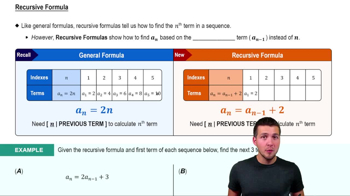
Recursive Formulas

Definite Integral

A definite integral calculates the accumulation of a quantity, represented as the area under a curve, between two specified limits. In this case, the integral from 0 to π of sin^m x provides a specific numerical value that represents the area under the curve of sin^m x over the interval [0, π], which is crucial for applying the reduction formula.
Video consigliato:
Percorso guidato
05:43
Definition of the Definite Integral

Wallis Product

The Wallis product is an infinite product that relates to the values of sine and cosine functions and is used to derive various results in calculus, particularly in evaluating integrals. It is significant in the context of this problem as it connects the reduction formula to the broader implications of sine integrals and their convergence properties.
Video consigliato:
05:18
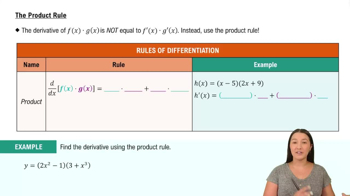
The Product Rule