Ch. 8 - Integration Techniques
Briggs - Calculus: Early Transcendentals 3rd Edition
Briggs3rd EditionCalculus: Early TranscendentalsISBN: 9780136847243Non è quello che usi tu?Cambia libro di testo
Capitolo 8, Problema 8.R.106

106. Arc length Find the length of the curve y = (x / 2) * sqrt(3 - x^2) + (3 / 2) * sin^(-1)(x / sqrt(3)) from x = 0 to x = 1.

Guida verificata passo dopo passo
1
Identify the formula for the arc length of a curve defined by a function \( y = f(x) \) from \( x = a \) to \( x = b \): \[ L = \int_a^b \sqrt{1 + \left(\frac{dy}{dx}\right)^2} \, dx \]
Given the function: \[ y = \frac{x}{2} \sqrt{3 - x^2} + \frac{3}{2} \sin^{-1}\left(\frac{x}{\sqrt{3}}\right) \] we need to find its derivative \( \frac{dy}{dx} \). Use the product rule and chain rule for the first term, and the derivative of the inverse sine function for the second term.
Compute \( \frac{dy}{dx} \) step-by-step: - For the first term \( \frac{x}{2} \sqrt{3 - x^2} \), write it as \( \frac{x}{2} (3 - x^2)^{1/2} \) and apply the product rule: \[ \frac{d}{dx} \left( \frac{x}{2} (3 - x^2)^{1/2} \right) = \frac{1}{2} (3 - x^2)^{1/2} + \frac{x}{2} \cdot \frac{d}{dx} (3 - x^2)^{1/2} \] - For the derivative of \( (3 - x^2)^{1/2} \), use the chain rule: \[ \frac{d}{dx} (3 - x^2)^{1/2} = \frac{1}{2} (3 - x^2)^{-1/2} \cdot (-2x) = -\frac{x}{(3 - x^2)^{1/2}} \] - For the second term \( \frac{3}{2} \sin^{-1}\left(\frac{x}{\sqrt{3}}\right) \), use the derivative of \( \sin^{-1}(u) \): \[ \frac{d}{dx} \sin^{-1}(u) = \frac{1}{\sqrt{1 - u^2}} \cdot \frac{du}{dx} \] where \( u = \frac{x}{\sqrt{3}} \), so \( \frac{du}{dx} = \frac{1}{\sqrt{3}} \).
After finding \( \frac{dy}{dx} \), square it to get \( \left(\frac{dy}{dx}\right)^2 \). Then, substitute into the arc length integral formula: \[ L = \int_0^1 \sqrt{1 + \left(\frac{dy}{dx}\right)^2} \, dx \]
Set up the integral with the expression inside the square root simplified as much as possible. Finally, evaluate the integral either by analytical methods if possible or by numerical approximation to find the length of the curve from \( x = 0 \) to \( x = 1 \).

Risposta video verificata per un problema simile:

Questa soluzione video è stata consigliata dai nostri tutor come utile per risolvere questo problema.
Durata del video:
6m

Concetti chiave

Ecco i concetti essenziali che devi comprendere per rispondere correttamente alla domanda.

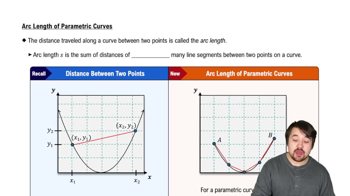
Arc Length Formula

The arc length of a curve y = f(x) from x = a to x = b is found using the integral L = ∫_a^b √(1 + (dy/dx)^2) dx. This formula calculates the length by summing infinitesimal line segments along the curve, requiring the derivative of the function.
Video consigliato:
Percorso guidato
06:29
Arc Length of Parametric Curves

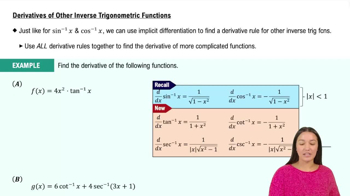
Derivative of Composite and Inverse Functions

To find dy/dx for the given function, one must differentiate terms involving products, square roots, and inverse sine functions. Understanding the chain rule and derivatives of inverse trigonometric functions like sin^(-1)(x) is essential.
Video consigliato:
06:35
Derivatives of Other Inverse Trigonometric Functions

Integration Techniques

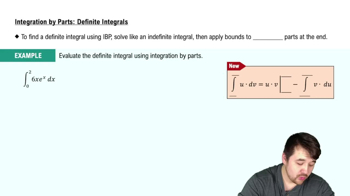
After finding the integrand √(1 + (dy/dx)^2), evaluating the integral may require substitution or recognizing standard integral forms. Proficiency in integration methods helps in simplifying and computing the definite integral for arc length.
Video consigliato:
Percorso guidato
06:18
Integration by Parts for Definite Integrals