Ch. 8 - Integration Techniques
Briggs - Calculus: Early Transcendentals 3rd Edition
Briggs3rd EditionCalculus: Early TranscendentalsISBN: 9780136847243Non è quello che usi tu?Cambia libro di testo
Capitolo 8, Problema 8.R.110

110. Comparing distances Suppose two cars started at the same time and place (t = 0 and s = 0). The velocity of car A (in mi/hr) is given by
u(t) = 40 / (t + 1) and the velocity of car B (in mi/hr) is given by v(t) = 40 * e^(-t/2).
b. After t = 3 hr, which car has traveled farther?

Guida verificata passo dopo passo
1
Recall that the distance traveled by a car from time \(t=0\) to \(t=3\) is the integral of its velocity function over that interval. So, for each car, we need to compute \(\int_0^3 u(t) \, dt\) and \(\int_0^3 v(t) \, dt\) respectively.
Set up the integral for car A's distance: \(\int_0^3 \frac{40}{t+1} \, dt\). This integral involves a rational function and can be solved using the natural logarithm function.
Set up the integral for car B's distance: \(\int_0^3 40 e^{-t/2} \, dt\). This integral involves an exponential function and can be solved using the formula for integrating exponentials.
Evaluate both integrals separately by applying the appropriate integration techniques: for car A, use the substitution \(u = t+1\); for car B, use the standard integral \(\int e^{kt} dt = \frac{1}{k} e^{kt} + C\).
After finding the expressions for the distances traveled by both cars at \(t=3\), compare the two values to determine which car has traveled farther.

Risposta video verificata per un problema simile:

Questa soluzione video è stata consigliata dai nostri tutor come utile per risolvere questo problema.
Durata del video:
4m

Concetti chiave

Ecco i concetti essenziali che devi comprendere per rispondere correttamente alla domanda.

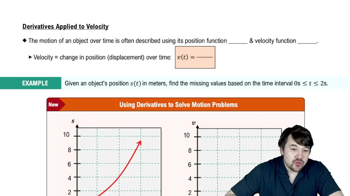
Velocity and Displacement Relationship

Velocity is the rate of change of displacement with respect to time. To find the total distance traveled by an object over a time interval, you integrate its velocity function over that interval. This integral gives the displacement, which in this context represents the distance traveled by each car.
Video consigliato:
Percorso guidato
06:29
Derivatives Applied To Velocity

Definite Integration

Definite integration calculates the accumulated quantity, such as distance, over a specific interval. Here, integrating the velocity functions from t = 0 to t = 3 hours will yield the total distance each car has traveled. Understanding how to set up and evaluate these integrals is essential.
Video consigliato:
Percorso guidato
05:43
Definition of the Definite Integral

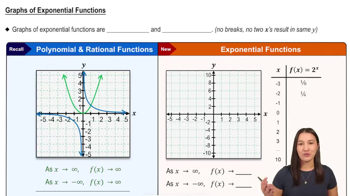
Exponential and Rational Functions

The velocity functions involve different types of functions: car A's velocity is a rational function, and car B's velocity is an exponential decay function. Recognizing their forms helps in choosing appropriate integration techniques and understanding how their speeds change over time.
Video consigliato:
5:46
Graphs of Exponential Functions