Ch. 8 - Integration Techniques
Briggs - Calculus: Early Transcendentals 3rd Edition
Briggs3rd EditionCalculus: Early TranscendentalsISBN: 9780136847243Non è quello che usi tu?Cambia libro di testo
Capitolo 8, Problema 8.1.24

7–64. Integration review Evaluate the following integrals.
24. ∫ from 0 to θ of (x⁵⸍² - x¹⸍²) / x³⸍² dx

Guida verificata passo dopo passo
1
Step 1: Simplify the integrand. The given integrand is \( \frac{x^{5/2} - x^{1/2}}{x^{3/2}} \). Use the property of exponents \( \frac{a^m}{a^n} = a^{m-n} \) to simplify each term: \( \frac{x^{5/2}}{x^{3/2}} = x^{(5/2 - 3/2)} = x^1 \) and \( \frac{x^{1/2}}{x^{3/2}} = x^{(1/2 - 3/2)} = x^{-1} \). The integrand simplifies to \( x - x^{-1} \).
Step 2: Set up the integral with the simplified integrand. The integral becomes \( \int_{0}^{\theta} (x - x^{-1}) \, dx \).
Step 3: Split the integral into two separate terms. Using the linearity of integration, rewrite the integral as \( \int_{0}^{\theta} x \, dx - \int_{0}^{\theta} x^{-1} \, dx \).
Step 4: Compute the antiderivative of each term. For \( \int x \, dx \), the antiderivative is \( \frac{x^2}{2} \). For \( \int x^{-1} \, dx \), the antiderivative is \( \ln|x| \). Substitute these results into the integral: \( \left[ \frac{x^2}{2} \right]_{0}^{\theta} - \left[ \ln|x| \right]_{0}^{\theta} \).
Step 5: Apply the limits of integration. Substitute \( x = \theta \) and \( x = 0 \) into the antiderivatives. Be cautious with \( \ln|x| \) at \( x = 0 \), as it is undefined. This suggests the integral may need further consideration for convergence at the lower limit.

Risposta video verificata per un problema simile:

Questa soluzione video è stata consigliata dai nostri tutor come utile per risolvere questo problema.
Durata del video:
3m

Concetti chiave

Ecco i concetti essenziali che devi comprendere per rispondere correttamente alla domanda.

Definite Integrals

A definite integral calculates the accumulation of a function's values over a specific interval, represented as ∫ from a to b f(x) dx. It provides the net area under the curve of the function f(x) between the limits a and b. In this question, the integral is evaluated from 0 to θ, indicating the area under the curve from x = 0 to x = θ.
Video consigliato:
Percorso guidato
05:43
Definition of the Definite Integral

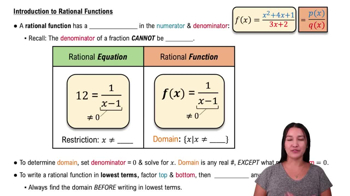
Simplifying Rational Functions

Rational functions are ratios of polynomials, and simplifying them often involves factoring and reducing terms. In the given integral, the expression (x⁵/2 - x¹/2) / x³/2 can be simplified by dividing each term in the numerator by the denominator. This simplification is crucial for making the integral easier to evaluate.
Video consigliato:
6:04
Intro to Rational Functions

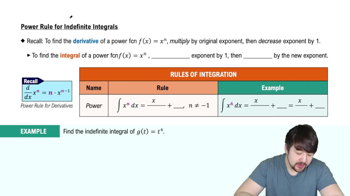
Power Rule for Integration

The power rule for integration states that ∫ x^n dx = (x^(n+1))/(n+1) + C, where n ≠ -1. This rule is essential for integrating polynomial functions, as it allows for straightforward computation of the integral. In this problem, applying the power rule will help in finding the antiderivative of the simplified function before evaluating the definite integral.
Video consigliato:
Percorso guidato
04:04
Power Rule for Indefinite Integrals