
Ch. 8 - Integration Techniques
Briggs - Calculus: Early Transcendentals 3rd Edition
Briggs3rd EditionCalculus: Early TranscendentalsISBN: 9780136847243Non è quello che usi tu?Cambia libro di testo
Capitolo 8, Problema 8.6.94

92–98. Evaluate the following integrals.
94. ∫ (dt / (t³ + 1))

Guida verificata passo dopo passo
1
Step 1: Recognize that the integral ∫ (dt / (t³ + 1)) involves a rational function. To simplify, factor the denominator t³ + 1 using the sum of cubes formula: t³ + 1 = (t + 1)(t² - t + 1).
Step 2: Use partial fraction decomposition to express 1 / (t³ + 1) as a sum of simpler fractions. Assume the form: 1 / (t³ + 1) = A / (t + 1) + (Bt + C) / (t² - t + 1), where A, B, and C are constants to be determined.
Step 3: Multiply through by the denominator (t³ + 1) to eliminate the fractions, resulting in: 1 = A(t² - t + 1) + (Bt + C)(t + 1). Expand and collect like terms to solve for A, B, and C.
Step 4: Once A, B, and C are determined, rewrite the integral as the sum of two simpler integrals: ∫ (A / (t + 1)) dt + ∫ ((Bt + C) / (t² - t + 1)) dt. Each term can now be integrated separately.
Step 5: For the first term, ∫ (A / (t + 1)) dt, use the natural logarithm rule: ∫ (1 / u) du = ln|u|. For the second term, ∫ ((Bt + C) / (t² - t + 1)) dt, consider substitution or recognize standard forms of integrals involving quadratic denominators. Combine the results to express the final solution.

Risposta video verificata per un problema simile:

Questa soluzione video è stata consigliata dai nostri tutor come utile per risolvere questo problema.
Durata del video:
11m

Concetti chiave

Ecco i concetti essenziali che devi comprendere per rispondere correttamente alla domanda.

Integration

Integration is a fundamental concept in calculus that involves finding the accumulated area under a curve represented by a function. It is the reverse process of differentiation and is used to calculate quantities such as areas, volumes, and total accumulated change. The integral can be definite, providing a numerical value over a specific interval, or indefinite, resulting in a general form of antiderivatives.
Video consigliato:
Percorso guidato
06:18
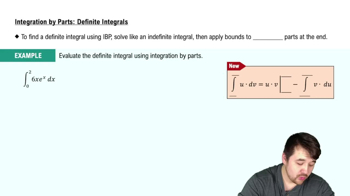
Integration by Parts for Definite Integrals

Partial Fraction Decomposition

Partial fraction decomposition is a technique used to break down complex rational functions into simpler fractions that are easier to integrate. This method is particularly useful when the denominator can be factored into linear or irreducible quadratic factors. By expressing the integrand as a sum of simpler fractions, one can integrate each term individually, simplifying the overall integration process.
Video consigliato:
Percorso guidato
10:07
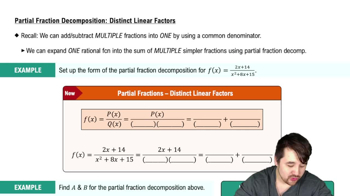
Partial Fraction Decomposition: Distinct Linear Factors

Improper Integrals

Improper integrals are integrals that involve infinite limits of integration or integrands that approach infinity within the interval of integration. To evaluate these integrals, one typically takes the limit of a definite integral as it approaches the problematic point. Understanding how to handle improper integrals is crucial for evaluating integrals that may not converge in the traditional sense, ensuring that the results are meaningful.
Video consigliato:
Percorso guidato
11:11
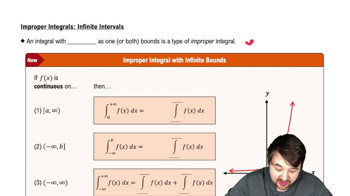
Improper Integrals: Infinite Intervals