Ch. 8 - Integration Techniques
Briggs - Calculus: Early Transcendentals 3rd Edition
Briggs3rd EditionCalculus: Early TranscendentalsISBN: 9780136847243Non è quello che usi tu?Cambia libro di testo
Capitolo 8, Problema 8.6.64

7–84. Evaluate the following integrals.
64. ∫ (ln(ax))/x dx, where a ≠ 0

Guida verificata passo dopo passo
1
Step 1: Recognize the integral ∫ (ln(ax))/x dx as a logarithmic function. To simplify, use the property of logarithms: ln(ax) = ln(a) + ln(x). This allows us to rewrite the integral as ∫ (ln(a) + ln(x))/x dx.
Step 2: Split the integral into two separate terms using the linearity of integration: ∫ (ln(a) + ln(x))/x dx = ∫ (ln(a)/x) dx + ∫ (ln(x)/x) dx.
Step 3: Evaluate the first term ∫ (ln(a)/x) dx. Since ln(a) is a constant (a ≠ 0), it can be factored out of the integral: ln(a) ∫ (1/x) dx. The integral of 1/x is ln|x|, so this term becomes ln(a) * ln|x|.
Step 4: Evaluate the second term ∫ (ln(x)/x) dx. This integral is a standard result in calculus and is equal to (1/2) * (ln(x))^2. This result can be derived using integration by parts, but for now, we use the known formula.
Step 5: Combine the results from Step 3 and Step 4. The final expression for the integral is ln(a) * ln|x| + (1/2) * (ln(x))^2 + C, where C is the constant of integration.

Risposta video verificata per un problema simile:

Questa soluzione video è stata consigliata dai nostri tutor come utile per risolvere questo problema.
Durata del video:
1m

Concetti chiave

Ecco i concetti essenziali che devi comprendere per rispondere correttamente alla domanda.

Integration

Integration is a fundamental concept in calculus that involves finding the integral of a function, which represents the area under the curve of that function. It is the reverse process of differentiation and can be used to calculate quantities such as total accumulation or area. Understanding the rules and techniques of integration, such as substitution and integration by parts, is essential for solving integral problems.
Video consigliato:
Percorso guidato
06:18
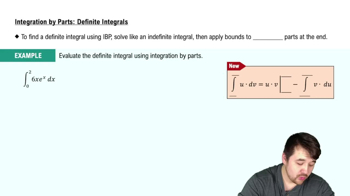
Integration by Parts for Definite Integrals

Natural Logarithm

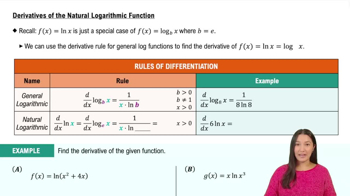
The natural logarithm, denoted as ln(x), is the logarithm to the base e, where e is approximately equal to 2.71828. It is a key function in calculus, particularly in integration and differentiation, due to its unique properties, such as the fact that the derivative of ln(x) is 1/x. In the context of the integral ∫ (ln(ax))/x dx, recognizing how to manipulate logarithmic expressions is crucial for simplification.
Video consigliato:
05:18
Derivative of the Natural Logarithmic Function

Integration by Parts

Integration by parts is a technique used to integrate products of functions. It is based on the product rule for differentiation and is expressed by the formula ∫ u dv = uv - ∫ v du, where u and v are differentiable functions. This method is particularly useful when dealing with integrals involving logarithmic functions, such as the one in the question, allowing for the transformation of the integral into a more manageable form.
Video consigliato:
Percorso guidato
06:18
Integration by Parts for Definite Integrals