Ch. 8 - Integration Techniques
Briggs - Calculus: Early Transcendentals 3rd Edition
Briggs3rd EditionCalculus: Early TranscendentalsISBN: 9780136847243Non è quello che usi tu?Cambia libro di testo
Capitolo 8, Problema 8.9.94

94. The family f(x) = 1/xᵖ revisited Consider the family of functions f(x) = 1/xᵖ, where p is a real number.
For what values of p does the integral ∫(1 to ∞) 1/xᵖ dx exist?
What is its value when it exists?

Guida verificata passo dopo passo
1
Identify the integral to evaluate: \(\displaystyle \int_1^{\infty} \frac{1}{x^p} \, dx\) where \(p\) is a real number.
Rewrite the integral as an improper integral with a limit: \(\displaystyle \lim_{t \to \infty} \int_1^t x^{-p} \, dx\).
Find the antiderivative of the integrand \(x^{-p}\). For \(p \neq 1\), the antiderivative is \(\displaystyle \frac{x^{-p+1}}{-p+1} + C\).
Evaluate the definite integral from 1 to \(t\): \(\displaystyle \int_1^t x^{-p} \, dx = \left[ \frac{x^{-p+1}}{-p+1} \right]_1^t = \frac{t^{-p+1} - 1}{-p+1}\).
Analyze the limit as \(t \to \infty\) to determine for which values of \(p\) the integral converges. Specifically, consider the behavior of \(t^{-p+1}\) as \(t \to \infty\) and find the condition on \(p\) that makes the limit finite.

Risposta video verificata per un problema simile:

Questa soluzione video è stata consigliata dai nostri tutor come utile per risolvere questo problema.
Durata del video:
3m

Concetti chiave

Ecco i concetti essenziali che devi comprendere per rispondere correttamente alla domanda.

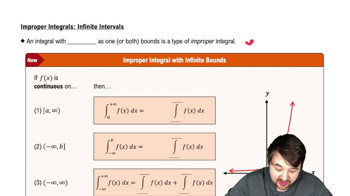
Improper Integrals

Improper integrals involve integration over an infinite interval or where the integrand becomes unbounded. To determine convergence, we evaluate the limit of the definite integral as the upper bound approaches infinity. If this limit exists and is finite, the integral converges; otherwise, it diverges.
Video consigliato:
Percorso guidato
11:11
Improper Integrals: Infinite Intervals

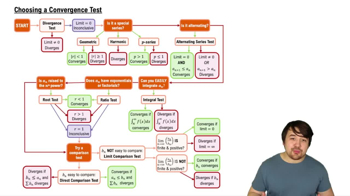
Power Functions and p-Test for Convergence

The p-test helps determine the convergence of integrals of the form ∫(1 to ∞) 1/x^p dx. Specifically, the integral converges if and only if p > 1, and diverges otherwise. This is because the decay rate of 1/x^p must be sufficiently fast to produce a finite area under the curve.
Video consigliato:
Percorso guidato
07:51
Choosing a Convergence Test

Evaluating Definite Integrals of Power Functions

To find the value of ∫(1 to ∞) 1/x^p dx when it converges, we compute the antiderivative of x^(-p), which is (x^(-p+1))/(-p+1) for p ≠ 1, and then evaluate the limit as the upper bound approaches infinity. This process yields a finite value when p > 1.
Video consigliato:
Percorso guidato
05:43
Definition of the Definite Integral