
Ch. 8 - Integration Techniques
Briggs - Calculus: Early Transcendentals 3rd Edition
Briggs3rd EditionCalculus: Early TranscendentalsISBN: 9780136847243Non è quello che usi tu?Cambia libro di testo
Capitolo 8, Problema 8.5.35

23-64. Integration Evaluate the following integrals.
35. ∫ (x² + 12x - 4)/(x³ - 4x) dx

Guida verificata passo dopo passo
1
Start by examining the integrand \( \frac{x^{2} + 12x - 4}{x^{3} - 4x} \). Notice that the denominator can be factored to simplify the expression. Factor \( x^{3} - 4x \) as \( x(x^{2} - 4) \), and further factor \( x^{2} - 4 \) as \( (x - 2)(x + 2) \). So the denominator becomes \( x(x - 2)(x + 2) \).
Rewrite the integral as \( \int \frac{x^{2} + 12x - 4}{x(x - 2)(x + 2)} \, dx \). Since the denominator is factored into linear terms, set up a partial fraction decomposition: \[ \frac{x^{2} + 12x - 4}{x(x - 2)(x + 2)} = \frac{A}{x} + \frac{B}{x - 2} + \frac{C}{x + 2} \], where \( A, B, C \) are constants to be determined.
Multiply both sides of the equation by the denominator \( x(x - 2)(x + 2) \) to clear the fractions: \[ x^{2} + 12x - 4 = A(x - 2)(x + 2) + B x (x + 2) + C x (x - 2) \].
Expand the right-hand side and collect like terms in powers of \( x \). Then, equate the coefficients of \( x^{2} \), \( x \), and the constant term on both sides to form a system of equations for \( A, B, C \).
Solve the system of equations to find the values of \( A, B, C \). Once found, rewrite the integral as the sum of simpler integrals: \[ \int \frac{A}{x} \, dx + \int \frac{B}{x - 2} \, dx + \int \frac{C}{x + 2} \, dx \]. Each of these integrals can be evaluated using the natural logarithm function.

Risposta video verificata per un problema simile:

Questa soluzione video è stata consigliata dai nostri tutor come utile per risolvere questo problema.
Durata del video:
11m

Concetti chiave

Ecco i concetti essenziali che devi comprendere per rispondere correttamente alla domanda.

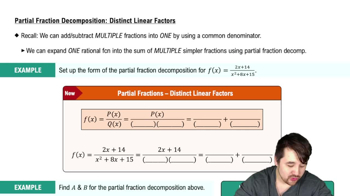
Partial Fraction Decomposition

Partial fraction decomposition is a technique used to break down a complex rational function into simpler fractions that are easier to integrate. It involves expressing the integrand as a sum of fractions with simpler denominators, typically linear or quadratic factors. This method is essential when integrating rational functions where the degree of the numerator is less than the degree of the denominator.
Video consigliato:
Percorso guidato
10:07
Partial Fraction Decomposition: Distinct Linear Factors

Polynomial Factorization

Polynomial factorization involves expressing a polynomial as a product of its factors, such as linear or quadratic terms. Factoring the denominator is crucial before applying partial fraction decomposition, as it reveals the simpler components needed for the decomposition. For example, factoring x³ - 4x as x(x² - 4) = x(x - 2)(x + 2) helps identify the terms in the denominator.
Video consigliato:
07:00
Taylor Polynomials

Integration of Rational Functions

Integration of rational functions often requires rewriting the integrand into a form that can be integrated using standard formulas. After partial fraction decomposition, each simpler fraction corresponds to a known integral type, such as logarithmic or arctangent functions. Understanding these integral forms allows for the evaluation of the original integral step-by-step.
Video consigliato:
6:04
Intro to Rational Functions