Ch. 9 - Differential Equations
Briggs - Calculus: Early Transcendentals 3rd Edition
Briggs3rd EditionCalculus: Early TranscendentalsISBN: 9780136847243Non è quello che usi tu?Cambia libro di testo
Capitolo 9, Problema 9.2.38b

38–43. Equilibrium solutions A differential equation of the form y′(t)=f(y) is said to be autonomous (the function f depends only on y). The constant function y=y0 is an equilibrium solution of the equation provided f(y0)=0 (because then y'(t)=0 and the solution remains constant for all t). Note that equilibrium solutions correspond to horizontal lines in the direction field. Note also that for autonomous equations, the direction field is independent of t. Carry out the following analysis on the given equations.
b. Sketch the direction field, for t≥0.


y′(t) = 2y + 4

Guida verificata passo dopo passo
1
Identify the given autonomous differential equation: \(y'(t) = 2y + 4\). Since it depends only on \(y\), it fits the form \(y'(t) = f(y)\) with \(f(y) = 2y + 4\).
Find the equilibrium solution(s) by setting \(f(y) = 0\), which means solving \(2y + 4 = 0\) for \(y\). This gives the constant solution(s) where the slope is zero.
Understand that the direction field consists of small line segments at various points \((t, y)\) with slope given by \(y'(t) = 2y + 4\). Since the equation is autonomous, the slope depends only on \(y\), not on \(t\).
To sketch the direction field for \(t \geq 0\), choose several values of \(y\) (both above and below the equilibrium solution) and calculate the slope \(2y + 4\) at each. Draw short line segments with these slopes at points along the vertical lines for different \(t\) values.
Note that at the equilibrium solution, the slope is zero, so the direction field will have horizontal line segments. For \(y\) values greater than the equilibrium, the slope will be positive (lines slanting upward), and for \(y\) values less than the equilibrium, the slope will be negative (lines slanting downward). This helps visualize the behavior of solutions over time.

Risposta video verificata per un problema simile:

Questa soluzione video è stata consigliata dai nostri tutor come utile per risolvere questo problema.
Durata del video:
4m

Concetti chiave

Ecco i concetti essenziali che devi comprendere per rispondere correttamente alla domanda.

Autonomous Differential Equations

An autonomous differential equation has the form y' = f(y), where the rate of change depends only on y, not explicitly on t. This means the behavior of solutions depends solely on the current value of y, making the direction field invariant along the t-axis. Understanding this helps in analyzing solution curves and equilibrium points.
Video consigliato:
07:39
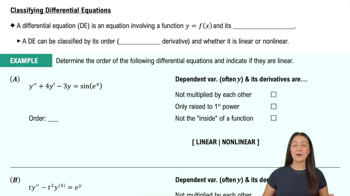
Classifying Differential Equations

Equilibrium Solutions

Equilibrium solutions occur where y' = f(y) = 0, meaning the solution y(t) remains constant over time. These correspond to horizontal lines in the direction field and represent steady states of the system. Identifying equilibrium points is crucial for sketching direction fields and understanding long-term behavior.
Video consigliato:
04:00
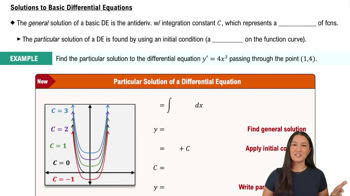
Solutions to Basic Differential Equations

Direction Fields (Slope Fields)

A direction field is a graphical tool that shows the slope y' = f(t,y) at various points in the plane. For autonomous equations, slopes depend only on y, so the field is uniform in t. Sketching direction fields helps visualize solution trajectories and stability of equilibria without solving the equation explicitly.
Video consigliato:
05:45
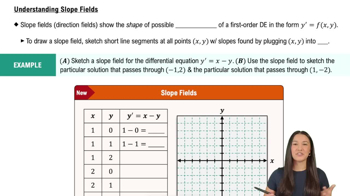
Understanding Slope Fields
Pratica correlata
Domanda del libro di testo

Explain why or why not Determine whether the following statements are true and give an explanation or counterexample.

b. Euler’s method is used to compute exact values of the solution of an initial value problem. 

62
views

Domanda del libro di testo

Explain why or why not Determine whether the following statements are true and give an explanation or counterexample.


b. The solution of a stirred tank initial value problem always approaches a constant as t→∞

56
views
Domanda del libro di testo

Blowup in finite time Consider the initial value problem y'(t) = yⁿ + 1, y(0) = y₀, where n is a positive integer.

b. Solve the initial value problem with n = 2 and y₀ = 1/√2.

89
views
Domanda del libro di testo

23–26. Stirred tank reactions For each of the following stirred tank reactions, carry out the following analysis.

b. Solve the initial value problem.


A one-million-liter pond is contaminated by a chemical pollutant with a concentration of 20 g/L. The source of the pollutant is removed, and pure water is allowed to flow into the pond at a rate of 1200 L/hr. Assuming the pond is thoroughly mixed and drained at a rate of 1200 L/hr, how long does it take to reduce the concentration of the solution in the pond to 10% of the initial value?

59
views
Domanda del libro di testo

17–20. Increasing and decreasing solutions Consider the following differential equations. A detailed direction field is not needed.


b. In what regions are solutions increasing? Decreasing?


y'(t) = y(y+3)(4-y)

70
views
Domanda del libro di testo

38–43. Equilibrium solutions A differential equation of the form y′(t)=f(y) is said to be autonomous (the function f depends only on y). The constant function y=y0 is an equilibrium solution of the equation provided f(y0)=0 (because then y'(t)=0 and the solution remains constant for all t). Note that equilibrium solutions correspond to horizontal lines in the direction field. Note also that for autonomous equations, the direction field is independent of t. Carry out the following analysis on the given equations.

b. Sketch the direction field, for t≥0. 


y′(t) = 6 - 2y

26
views