Ch. 9 - Differential Equations
Briggs - Calculus: Early Transcendentals 3rd Edition
Briggs3rd EditionCalculus: Early TranscendentalsISBN: 9780136847243Non è quello che usi tu?Cambia libro di testo
Capitolo 9, Problema 9.3.53b

Blowup in finite time Consider the initial value problem y'(t) = yⁿ + 1, y(0) = y₀, where n is a positive integer.
b. Solve the initial value problem with n = 2 and y₀ = 1/√2.

Guida verificata passo dopo passo
1
Start with the given initial value problem: \(y'(t) = y^2 + 1\) with initial condition \(y(0) = \frac{1}{\sqrt{2}}\).
Rewrite the differential equation in separable form: \(\frac{dy}{dt} = y^2 + 1\) implies \(\frac{dy}{y^2 + 1} = dt\).
Integrate both sides: integrate \(\int \frac{dy}{y^2 + 1}\) on the left and \(\int dt\) on the right. Recall that \(\int \frac{dy}{y^2 + 1} = \arctan(y) + C\).
After integration, write the implicit solution: \(\arctan(y) = t + C\). Use the initial condition \(y(0) = \frac{1}{\sqrt{2}}\) to solve for the constant \(C\) by substituting \(t=0\) and \(y=\frac{1}{\sqrt{2}}\).
Finally, solve for \(y\) explicitly by taking the tangent of both sides: \(y = \tan(t + C)\), which gives the solution to the initial value problem.

Risposta video verificata per un problema simile:

Questa soluzione video è stata consigliata dai nostri tutor come utile per risolvere questo problema.
Durata del video:
5m

Concetti chiave

Ecco i concetti essenziali che devi comprendere per rispondere correttamente alla domanda.

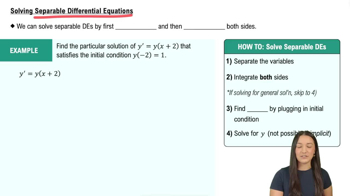
Separable Differential Equations

A separable differential equation can be written as dy/dt = g(y)h(t), allowing variables y and t to be separated on opposite sides of the equation. This enables integration with respect to each variable independently, which is essential for solving the given initial value problem.
Video consigliato:
06:06
Solving Separable Differential Equations

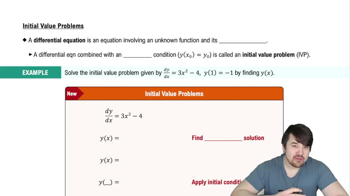
Initial Value Problem (IVP)

An initial value problem specifies a differential equation along with a condition y(t₀) = y₀. This condition allows determination of the particular solution from the family of general solutions by solving for the integration constant.
Video consigliato:
Percorso guidato
05:03
Initial Value Problems

Finite Time Blowup

Finite time blowup occurs when the solution to a differential equation becomes unbounded in a finite time interval. For nonlinear equations like y' = y² + 1, solutions can grow rapidly and approach infinity at a finite time, which is important to analyze after solving the IVP.
Video consigliato:
Percorso guidato
05:44
Algebra Rules for Finite Sums
Pratica correlata
Domanda del libro di testo

Properties of stirred tank solutions


b. Verify that M(0) = M₀

48
views

Domanda del libro di testo

Explain why or why not Determine whether the following statements are true and give an explanation or counterexample.

b. Euler’s method is used to compute exact values of the solution of an initial value problem. 

62
views
Domanda del libro di testo

Explain why or why not Determine whether the following statements are true and give an explanation or counterexample.


b. The solution of a stirred tank initial value problem always approaches a constant as t→∞

56
views
Domanda del libro di testo

38–43. Equilibrium solutions A differential equation of the form y′(t)=f(y) is said to be autonomous (the function f depends only on y). The constant function y=y0 is an equilibrium solution of the equation provided f(y0)=0 (because then y'(t)=0 and the solution remains constant for all t). Note that equilibrium solutions correspond to horizontal lines in the direction field. Note also that for autonomous equations, the direction field is independent of t. Carry out the following analysis on the given equations.

b. Sketch the direction field, for t≥0.


y′(t) = 2y + 4

67
views
Domanda del libro di testo

17–20. Increasing and decreasing solutions Consider the following differential equations. A detailed direction field is not needed.


b. In what regions are solutions increasing? Decreasing?


y'(t) = y(y+3)(4-y)

70
views
Domanda del libro di testo

38–43. Equilibrium solutions A differential equation of the form y′(t)=f(y) is said to be autonomous (the function f depends only on y). The constant function y=y0 is an equilibrium solution of the equation provided f(y0)=0 (because then y'(t)=0 and the solution remains constant for all t). Note that equilibrium solutions correspond to horizontal lines in the direction field. Note also that for autonomous equations, the direction field is independent of t. Carry out the following analysis on the given equations.

b. Sketch the direction field, for t≥0. 


y′(t) = 6 - 2y

26
views