
Ch. 9 - Differential Equations
Briggs - Calculus: Early Transcendentals 3rd Edition
Briggs3rd EditionCalculus: Early TranscendentalsISBN: 9780136847243Non è quello che usi tu?Cambia libro di testo
Capitolo 9, Problema 9.2.37b

Explain why or why not Determine whether the following statements are true and give an explanation or counterexample.
b. Euler’s method is used to compute exact values of the solution of an initial value problem. 

Guida verificata passo dopo passo
1
Recall that Euler's method is a numerical technique used to approximate solutions of initial value problems (IVPs) for differential equations, not to find exact solutions.
Understand that Euler's method works by taking small steps along the slope given by the differential equation, starting from the initial condition, to generate approximate values of the solution at discrete points.
Recognize that because Euler's method uses linear approximations over small intervals, the values it produces are approximations and generally contain some error compared to the exact solution.
Therefore, Euler's method does not compute exact values; instead, it provides an approximate solution that can be made more accurate by decreasing the step size.
Conclude that the statement 'Euler’s method is used to compute exact values of the solution of an initial value problem' is false, and the explanation is that Euler's method is inherently an approximation technique.

Risposta video verificata per un problema simile:

Questa soluzione video è stata consigliata dai nostri tutor come utile per risolvere questo problema.
Durata del video:
4m

Concetti chiave

Ecco i concetti essenziali che devi comprendere per rispondere correttamente alla domanda.

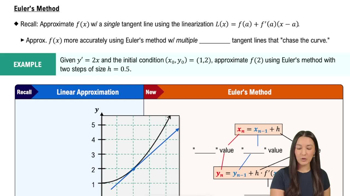
Euler’s Method

Euler’s method is a numerical technique used to approximate solutions of initial value problems for ordinary differential equations. It uses tangent line approximations at discrete steps to estimate the solution curve, rather than finding an exact formula.
Video consigliato:
07:33
Euler's Method

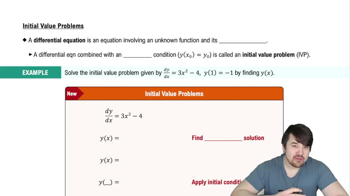
Initial Value Problem (IVP)

An initial value problem consists of a differential equation along with a specified value of the unknown function at a given point. The goal is to find a function that satisfies both the differential equation and the initial condition.
Video consigliato:
Percorso guidato
05:03
Initial Value Problems

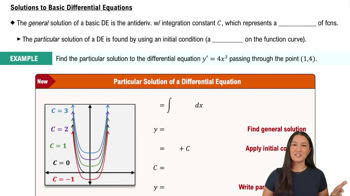
Exact vs. Approximate Solutions

Exact solutions satisfy the differential equation and initial conditions precisely, often expressed in closed-form formulas. Approximate solutions, like those from Euler’s method, provide numerical estimates that approach the exact solution as the step size decreases.
Video consigliato:
04:00
Solutions to Basic Differential Equations
Pratica correlata
Domanda del libro di testo

33–36. {Use of Tech} Computing Euler approximations Use a calculator or computer program to carry out the following steps.

b. Using the exact solution (also given), find the error in the approximation to y(T) (only at the right endpoint of the time interval).


y′(t) = -2y, y(0) = 1; Δt = 0.2, T = 2; y(t) = e⁻²ᵗ

49
views
Domanda del libro di testo

17–20. Increasing and decreasing solutions Consider the following differential equations. A detailed direction field is not needed.


b. In what regions are solutions increasing? Decreasing?


y'(t) = (y−1)(1+y)

47
views
Domanda del libro di testo

Properties of stirred tank solutions


b. Verify that M(0) = M₀

48
views
Domanda del libro di testo

Explain why or why not Determine whether the following statements are true and give an explanation or counterexample.


b. The solution of a stirred tank initial value problem always approaches a constant as t→∞

56
views
Domanda del libro di testo

Blowup in finite time Consider the initial value problem y'(t) = yⁿ + 1, y(0) = y₀, where n is a positive integer.

b. Solve the initial value problem with n = 2 and y₀ = 1/√2.

89
views
Domanda del libro di testo

38–43. Equilibrium solutions A differential equation of the form y′(t)=f(y) is said to be autonomous (the function f depends only on y). The constant function y=y0 is an equilibrium solution of the equation provided f(y0)=0 (because then y'(t)=0 and the solution remains constant for all t). Note that equilibrium solutions correspond to horizontal lines in the direction field. Note also that for autonomous equations, the direction field is independent of t. Carry out the following analysis on the given equations.

b. Sketch the direction field, for t≥0.


y′(t) = 2y + 4

67
views