
Ch. 9 - Differential Equations
Briggs - Calculus: Early Transcendentals 3rd Edition
Briggs3rd EditionCalculus: Early TranscendentalsISBN: 9780136847243Non è quello che usi tu?Cambia libro di testo
Capitolo 9, Problema 9.3.15

5–16. Solving separable equations Find the general solution of the following equations. Express the solution explicitly as a function of the independent variable.
u'(x) = e²ˣ⁻ᵘ

Guida verificata passo dopo passo
1
Rewrite the given differential equation \(u'(x) = e^{2x - u}\) in a form that separates the variables \(u\) and \(x\). This means expressing it as \(\frac{du}{dx} = e^{2x} \cdot e^{-u}\), which can be rearranged to isolate \(u\) terms on one side and \(x\) terms on the other.
Separate the variables by multiplying both sides by \(e^{u}\) and \(dx\), giving $e^{u} du = e^{2x} dx$. This sets up the equation so that all \(u\) terms are on the left and all \(x\) terms are on the right.
Integrate both sides: compute \(\int e^{u} du\) on the left and \(\int e^{2x} dx\) on the right. Remember to include the constant of integration after integrating.
After integration, you will have an implicit equation involving \(u\) and \(x\). Solve this equation algebraically to express \(u\) explicitly as a function of \(x\).
Finally, write the general solution \(u(x)\) including the constant of integration, which represents the family of solutions to the differential equation.

Risposta video verificata per un problema simile:

Questa soluzione video è stata consigliata dai nostri tutor come utile per risolvere questo problema.
Durata del video:
1m

Concetti chiave

Ecco i concetti essenziali che devi comprendere per rispondere correttamente alla domanda.

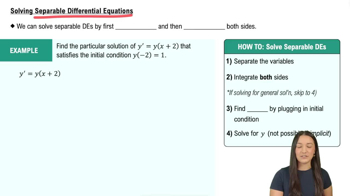
Separable Differential Equations

A separable differential equation can be written as a product of a function of the dependent variable and a function of the independent variable. This allows the variables to be separated on opposite sides of the equation, enabling integration with respect to each variable independently.
Video consigliato:
06:06
Solving Separable Differential Equations

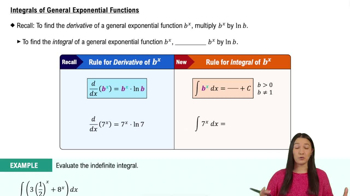
Integration of Exponential Functions

Integrating exponential functions involves recognizing the form e^(ax + b) and applying the rule ∫e^(ax + b) dx = (1/a)e^(ax + b) + C. This is essential when solving differential equations where the right-hand side contains exponential expressions.
Video consigliato:
05:11
Integrals of General Exponential Functions

Expressing the Solution Explicitly

After integrating, the solution often involves an implicit relation between variables. Expressing the solution explicitly means solving for the dependent variable as a function of the independent variable, which may require algebraic manipulation or applying inverse functions.
Video consigliato:
6:36
Simplifying Trig Expressions