Ch.12 - Parametric and Polar Curves
Briggs - Calculus: Early Transcendentals 3rd Edition
Briggs3rd EditionCalculus: Early TranscendentalsISBN: 9780136847243Non è quello che usi tu?Cambia libro di testo
Capitolo 12, Problema 12.4.21

13–30. Graphing conic sections Determine whether the following equations describe a parabola, an ellipse, or a hyperbola, and then sketch a graph of the curve. For each parabola, specify the location of the focus and the equation of the directrix; for each ellipse, label the coordinates of the vertices and foci, and find the lengths of the major and minor axes; for each hyperbola, label the coordinates of the vertices and foci, and find the equations of the asymptotes.


4x² - y² = 16

Guida verificata passo dopo passo
1
Rewrite the given equation 4x² - y² = 16 in a standard form by dividing both sides by 16 to isolate the terms: \(\frac{4x^{2}}{16} - \frac{y^{2}}{16} = 1\).
Simplify the fractions to get \(\frac{x^{2}}{4} - \frac{y^{2}}{16} = 1\), which matches the standard form of a hyperbola \(\frac{x^{2}}{a^{2}} - \frac{y^{2}}{b^{2}} = 1\) where \(a^{2} = 4\) and \(b^{2} = 16\).
Identify the center of the hyperbola at the origin (0,0), and note that since the \(x^{2}\) term is positive, the hyperbola opens left and right along the x-axis.
Find the vertices by using \(a = \sqrt{4} = 2\), so the vertices are at \((\pm 2, 0)\).
Calculate the foci using \(c = \sqrt{a^{2} + b^{2}} = \sqrt{4 + 16} = \sqrt{20}\), so the foci are at \((\pm \sqrt{20}, 0)\), and find the equations of the asymptotes using \(y = \pm \frac{b}{a} x = \pm \frac{4}{2} x = \pm 2x\).

Risposta video verificata per un problema simile:

Questa soluzione video è stata consigliata dai nostri tutor come utile per risolvere questo problema.
Durata del video:
6m

Concetti chiave

Ecco i concetti essenziali che devi comprendere per rispondere correttamente alla domanda.

Identification of Conic Sections from Equations

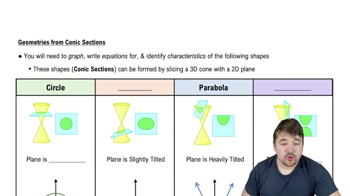
Conic sections are curves obtained by intersecting a plane with a double-napped cone. Their equations typically involve quadratic terms in x and y. By analyzing the signs and coefficients of x² and y² terms, one can classify the curve as a parabola, ellipse, or hyperbola. For example, if the equation has both squared terms with opposite signs, it represents a hyperbola.
Video consigliato:
Percorso guidato
3:08
Geometries from Conic Sections

Standard Forms and Properties of Conic Sections

Each conic section has a standard form equation revealing key features like vertices, foci, and axes. For hyperbolas, the standard form helps identify the center, vertices, foci, and asymptotes. Understanding how to rewrite the given equation into standard form is essential for graphing and labeling these elements accurately.
Video consigliato:
Percorso guidato
5:33
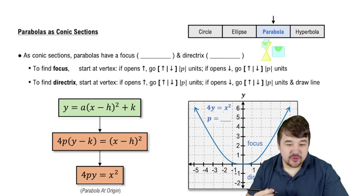
Parabolas as Conic Sections

Graphing and Key Features of Hyperbolas

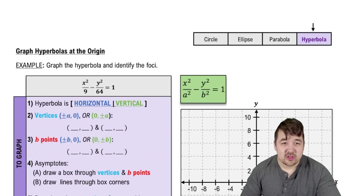
Graphing a hyperbola involves plotting its vertices and foci, and drawing its asymptotes, which guide the curve's shape. The vertices are points where the hyperbola intersects its principal axis, and the foci are fixed points defining the curve. Asymptotes are straight lines that the hyperbola approaches but never touches, determined by the equation's coefficients.
Video consigliato:
Percorso guidato
4:20
Graph Hyperbolas at the Origin