Ch.12 - Parametric and Polar Curves
Briggs - Calculus: Early Transcendentals 3rd Edition
Briggs3rd EditionCalculus: Early TranscendentalsISBN: 9780136847243Non è quello che usi tu?Cambia libro di testo
Capitolo 12, Problema 12.3.43

41–44. Intersection points and area  Find all the intersection points of the following curves. Find the area of the entire region that lies within both curves


r = 1 + sin θ and r = 1 + cos θ

Guida verificata passo dopo passo
1
Identify the curves given in polar coordinates: \( r = 1 + \sin \theta \) and \( r = 1 + \cos \theta \). Our goal is to find their intersection points and the area of the region common to both curves.
To find the intersection points, set the two expressions for \( r \) equal to each other: \( 1 + \sin \theta = 1 + \cos \theta \). Simplify this to \( \sin \theta = \cos \theta \).
Solve the equation \( \sin \theta = \cos \theta \) for \( \theta \). Recall that \( \sin \theta = \cos \theta \) implies \( \tan \theta = 1 \), so \( \theta = \frac{\pi}{4} + k\pi \) for integers \( k \). Determine which of these values lie within the interval \( [0, 2\pi) \) to find all intersection points.
For each intersection angle \( \theta \), substitute back into either curve equation to find the corresponding \( r \) value. This gives the polar coordinates \( (r, \theta) \) of the intersection points.
To find the area of the region common to both curves, set up an integral in polar coordinates. The area inside a polar curve \( r(\theta) \) from \( \alpha \) to \( \beta \) is given by \( \frac{1}{2} \int_{\alpha}^{\beta} r(\theta)^2 \, d\theta \). Determine the intervals where one curve lies inside the other, then integrate the minimum of the two \( r \) values squared over those intervals, and sum these areas to get the total common area.

Risposta video verificata per un problema simile:

Questa soluzione video è stata consigliata dai nostri tutor come utile per risolvere questo problema.
Durata del video:
5m

Concetti chiave

Ecco i concetti essenziali che devi comprendere per rispondere correttamente alla domanda.

Polar Coordinates and Curves

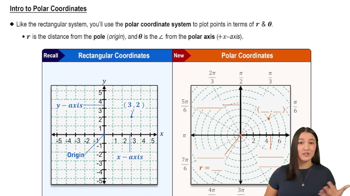
Polar coordinates represent points using a radius and an angle, with curves defined as r(θ). Understanding how to interpret and plot polar equations like r = 1 + sin θ and r = 1 + cos θ is essential for visualizing their shapes and intersection points.
Video consigliato:
05:32
Intro to Polar Coordinates

Finding Intersection Points in Polar Coordinates

To find intersection points of two polar curves, set their equations equal (r1 = r2) and solve for θ. This involves solving trigonometric equations and verifying solutions within the domain to identify all points where the curves meet.
Video consigliato:
05:32
Intro to Polar Coordinates

Area of Regions Bounded by Polar Curves

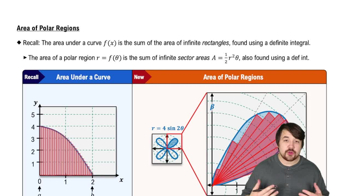
The area enclosed by a polar curve r(θ) between angles α and β is given by (1/2)∫αβ [r(θ)]² dθ. For the region inside both curves, calculate the overlapping area by integrating the minimum radius squared over the appropriate intervals.
Video consigliato:
Percorso guidato
07:45
Area of Polar Regions
Pratica correlata
Domanda del libro di testo

57–62. Polar equations for conic sections Graph the following conic sections, labeling the vertices, foci, directrices, and asymptotes (if they exist). Use a graphing utility to check your work.


r = 3/(2 + cos θ)

37
views

Domanda del libro di testo

13–30. Graphing conic sections Determine whether the following equations describe a parabola, an ellipse, or a hyperbola, and then sketch a graph of the curve. For each parabola, specify the location of the focus and the equation of the directrix; for each ellipse, label the coordinates of the vertices and foci, and find the lengths of the major and minor axes; for each hyperbola, label the coordinates of the vertices and foci, and find the equations of the asymptotes.


4x² - y² = 16

31
views
Domanda del libro di testo

45–60. Areas of regions Find the area of the following regions.


The region inside one leaf of the rose r = cos 5θ

48
views
Domanda del libro di testo

Golden Gate Bridge Completed in 1937, San Francisco’s Golden Gate Bridge is 2.7 km long and weighs about 890,000 tons. The length of the span between the two central towers is 1280 m; the towers themselves extend 152 m above the roadway. The cables that support the deck of the bridge between the two towers hang in a parabola (see figure). Assuming the origin is midway between the towers on the deck of the bridge, find an equation that describes the cables. How long is a guy wire that hangs vertically from the cables to the roadway 500 m from the center of the bridge? 

115
views
Domanda del libro di testo

63–66. Tracing hyperbolas and parabolas Graph the following equations. Then use arrows and labeled points to indicate how the curve is generated as θ increases from 0 to 2π. 


r = 3/(1 - cos θ)

45
views
Domanda del libro di testo

63–74. Arc length of polar curves Find the length of the following polar curves.


{Use of Tech} The complete limaçon r=4−2cosθ

96
views