Ch.12 - Parametric and Polar Curves
Briggs - Calculus: Early Transcendentals 3rd Edition
Briggs3rd EditionCalculus: Early TranscendentalsISBN: 9780136847243Non è quello che usi tu?Cambia libro di testo
Capitolo 12, Problema 12.R.31

27–32. Polar curves Graph the following equations.


r = 3 sin 4θ

Guida verificata passo dopo passo
1
Recognize that the given equation is a polar equation of the form \(r = 3 \sin(4\theta)\), where \(r\) is the radius and \(\theta\) is the angle in radians.
Understand that the function \(\sin(4\theta)\) will create a rose curve with petals. The number of petals for \(r = a \sin(n\theta)\) depends on \(n\): if \(n\) is even, the curve has \$2n$ petals; if $n$ is odd, it has $n$ petals. Since $n=4$ here, expect \(8\) petals.
Create a table of values by choosing several values of \(\theta\) between \(0\) and \(2\pi\), calculate \(r\) for each, and plot the points \((r, \theta)\) in polar coordinates. This helps visualize the shape of the curve.
Note the amplitude \(3\) controls the length of each petal, so the maximum radius of the petals will be \(3\). The petals will be symmetrically distributed around the origin due to the sine function and the multiple angle.
Sketch the curve by plotting the points and connecting them smoothly, ensuring the petals appear evenly spaced and reach out to radius \(3\) at their tips, forming the characteristic rose pattern.

Risposta video verificata per un problema simile:

Questa soluzione video è stata consigliata dai nostri tutor come utile per risolvere questo problema.
Durata del video:
4m

Concetti chiave

Ecco i concetti essenziali che devi comprendere per rispondere correttamente alla domanda.

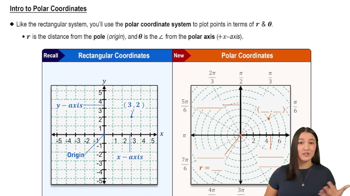
Polar Coordinates

Polar coordinates represent points in the plane using a radius and an angle (r, θ) instead of Cartesian coordinates (x, y). The radius r is the distance from the origin, and θ is the angle measured from the positive x-axis. Understanding this system is essential for graphing equations like r = 3 sin 4θ.
Video consigliato:
05:32
Intro to Polar Coordinates

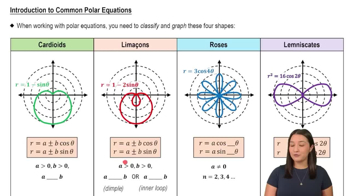
Graphing Polar Equations

Graphing polar equations involves plotting points by calculating r for various values of θ and then converting these to Cartesian coordinates if needed. Recognizing patterns, such as petals in rose curves, helps visualize the graph. For r = 3 sin 4θ, the number of petals and their orientation depend on the coefficient of θ.
Video consigliato:
3:47
Introduction to Common Polar Equations

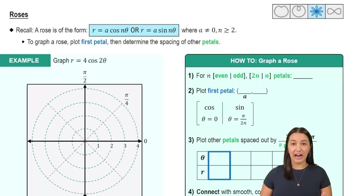
Rose Curves

Rose curves are a family of polar graphs defined by equations like r = a sin(nθ) or r = a cos(nθ). The parameter n determines the number of petals: if n is even, the curve has 2n petals; if odd, n petals. Understanding rose curves aids in predicting the shape and symmetry of r = 3 sin 4θ.
Video consigliato:
3:37
Roses