Ch.12 - Parametric and Polar Curves
Briggs - Calculus: Early Transcendentals 3rd Edition
Briggs3rd EditionCalculus: Early TranscendentalsISBN: 9780136847243Non è quello che usi tu?Cambia libro di testo
Capitolo 12, Problema 12.R.60b

A polar conic section Consider the equation r² = sec2θ
b. Find the vertices, foci, directrices, and eccentricity of the curve."

Guida verificata passo dopo passo
1
Rewrite the given polar equation \(r^2 = \sec^2 \theta\) in a more standard form. Recall that \(\sec \theta = \frac{1}{\cos \theta}\), so express \(r\) in terms of \(\theta\) and simplify accordingly.
Identify the type of conic by comparing the equation to the general polar conic form \(r = \frac{ed}{1 \pm e \cos \theta}\) or \(r = \frac{ed}{1 \pm e \sin \theta}\). This will help determine the eccentricity \(e\) and the directrix distance \(d\).
Find the eccentricity \(e\) by analyzing the relationship between \(r\) and \(\theta\) in the equation. Recall that eccentricity measures how much the conic deviates from being a circle.
Determine the vertices by finding the values of \(r\) when \(\theta\) corresponds to the maximum and minimum distances from the pole (origin). This usually happens when the denominator in the standard form is minimized or maximized.
Locate the foci and directrices using the eccentricity and the directrix distance. The focus is at the pole for polar conics, and the directrix lines are located at distances related to \(d\) along the polar axis.

Risposta video verificata per un problema simile:

Questa soluzione video è stata consigliata dai nostri tutor come utile per risolvere questo problema.
Durata del video:
9m

Concetti chiave

Ecco i concetti essenziali che devi comprendere per rispondere correttamente alla domanda.

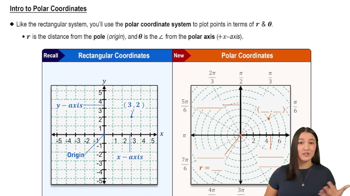
Polar Coordinates and Polar Equations

Polar coordinates represent points using a radius r and angle θ from the origin. Polar equations express curves in terms of r and θ, allowing the description of conic sections like circles, ellipses, parabolas, and hyperbolas in a coordinate system centered at the pole.
Video consigliato:
05:32
Intro to Polar Coordinates

Conic Sections in Polar Form

Conic sections can be represented in polar form using equations involving r, θ, eccentricity e, and directrix. The general form r = ed / (1 ± e cos θ) or r = ed / (1 ± e sin θ) relates the radius to the angle, eccentricity, and directrix, helping identify vertices, foci, and directrices.
Video consigliato:
Percorso guidato
5:33
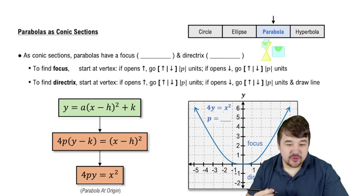
Parabolas as Conic Sections

Eccentricity, Vertices, Foci, and Directrices

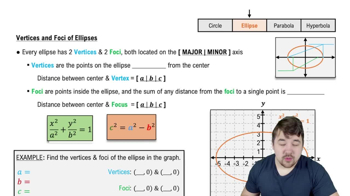
Eccentricity (e) measures how much a conic deviates from a circle; e=0 is a circle, 0<e<1 an ellipse, e=1 a parabola, and e>1 a hyperbola. Vertices are points closest or farthest from the pole, foci are fixed points defining the conic, and directrices are lines used to define the conic via the eccentricity.
Video consigliato:
Percorso guidato
5:30
Foci and Vertices of an Ellipse