Ch.12 - Parametric and Polar Curves
Briggs - Calculus: Early Transcendentals 3rd Edition
Briggs3rd EditionCalculus: Early TranscendentalsISBN: 9780136847243Non è quello che usi tu?Cambia libro di testo
Capitolo 12, Problema 12.R.1c

Explain why or why not Determine whether the following statements are true and give an explanation or counterexample.
c. The polar coordinates (3, -3π/4) and (-3, π/4) describe the same point in the plane.

Guida verificata passo dopo passo
1
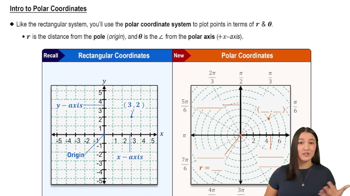
Recall that polar coordinates are given as \((r, \theta)\), where \(r\) is the radius (distance from the origin) and \(\theta\) is the angle measured from the positive x-axis.
Understand that the point described by polar coordinates \((r, \theta)\) can also be represented by \((-r, \theta + \pi)\) because moving in the opposite direction by \(\pi\) radians with a negative radius points to the same location.
Check the given coordinates: \((3, -\frac{3\pi}{4})\) and \((-3, \frac{\pi}{4})\). Notice that the second point has a negative radius and an angle \(\frac{\pi}{4}\).
Add \(\pi\) to the angle of the second point to see if it matches the first point's angle: \(\frac{\pi}{4} + \pi = \frac{5\pi}{4}\). Since \(-\frac{3\pi}{4}\) is coterminal with \(\frac{5\pi}{4}\) (they differ by \(2\pi\)), the angles correspond to the same direction.
Conclude that because \((-3, \frac{\pi}{4})\) is equivalent to \((3, \frac{5\pi}{4})\), which is coterminal with \((3, -\frac{3\pi}{4})\), both coordinates describe the same point in the plane.

Risposta video verificata per un problema simile:

Questa soluzione video è stata consigliata dai nostri tutor come utile per risolvere questo problema.
Durata del video:
3m

Concetti chiave

Ecco i concetti essenziali che devi comprendere per rispondere correttamente alla domanda.

Polar Coordinates and Their Representation

Polar coordinates represent points in the plane using a radius and an angle, written as (r, θ). The radius r is the distance from the origin, and θ is the angle measured from the positive x-axis. Points can have multiple polar representations due to angle periodicity and sign changes in r.
Video consigliato:
05:32
Intro to Polar Coordinates

Equivalence of Polar Coordinates with Negative Radius

A point with coordinates (r, θ) is equivalent to (-r, θ + π) because a negative radius means moving in the opposite direction along the line defined by θ. This property allows different pairs of (r, θ) to represent the same point by adjusting the angle by π when the radius is negative.
Video consigliato:
05:32
Intro to Polar Coordinates

Angle Periodicity in Polar Coordinates

Angles in polar coordinates are periodic with period 2π, meaning θ and θ + 2kπ (for any integer k) represent the same direction. This periodicity allows angles outside the standard interval [0, 2π) or (-π, π] to still describe the same point, which is important when comparing coordinates with angles like -3π/4 and π/4.
Video consigliato:
05:32
Intro to Polar Coordinates