Ch.12 - Parametric and Polar Curves
Briggs - Calculus: Early Transcendentals 3rd Edition
Briggs3rd EditionCalculus: Early TranscendentalsISBN: 9780136847243Non è quello che usi tu?Cambia libro di testo
Capitolo 12, Problema 12.4.31

31–38. Equations of parabolas Find an equation of the following parabolas. Unless otherwise specified, assume the vertex is at the origin.
A parabola that opens to the right with directrix x = -4

Guida verificata passo dopo passo
1
Recall the definition of a parabola: it is the set of all points equidistant from the focus and the directrix.
Since the directrix is given as the vertical line \(x = -4\) and the parabola opens to the right, the axis of symmetry is horizontal along the x-axis.
The vertex is at the origin \((0,0)\), so the focus must be on the positive x-axis, at some point \((p,0)\), where \(p > 0\).
The distance from the vertex to the directrix is \(|p| = 4\), so the focus is at \((4,0)\).
Use the standard form of a parabola that opens right: \(y^2 = 4px\). Substitute \(p = 4\) to get the equation \(y^2 = 16x\).

Risposta video verificata per un problema simile:

Questa soluzione video è stata consigliata dai nostri tutor come utile per risolvere questo problema.
Durata del video:
1m

Concetti chiave

Ecco i concetti essenziali che devi comprendere per rispondere correttamente alla domanda.

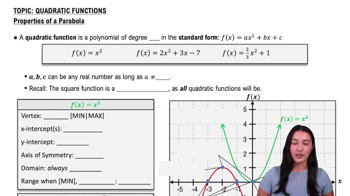
Definition of a Parabola

A parabola is the set of all points equidistant from a fixed point called the focus and a fixed line called the directrix. This geometric definition helps derive the equation of the parabola by relating distances from any point on the curve to the focus and directrix.
Video consigliato:
Percorso guidato
05:43
Definition of the Definite Integral

Orientation of Parabolas

The orientation of a parabola depends on the position of its focus and directrix. If the parabola opens right or left, its axis of symmetry is horizontal, and the equation involves x and y accordingly. For a parabola opening right, the directrix is vertical, and the equation typically has the form (y - k)^2 = 4p(x - h).
Video consigliato:
7:42
Properties of Parabolas

Vertex at the Origin and Directrix

When the vertex is at the origin, the parabola's equation simplifies since h = 0 and k = 0. Given the directrix x = -4, the focus lies on the opposite side of the vertex at x = 4, allowing calculation of the parameter p, which determines the distance from the vertex to the focus or directrix and shapes the parabola's equation.
Video consigliato:
Percorso guidato
5:59
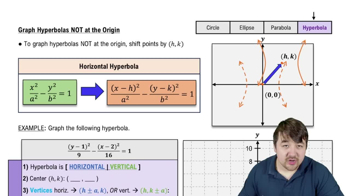
Graph Hyperbolas NOT at the Origin
Pratica correlata
Domanda del libro di testo

73–76. Tangent lines Find an equation of the line tangent to the curve at the point corresponding to the given value of t.


x=cos t+t sin t,y=sin t−t cos t; t=π/4

99
views

Domanda del libro di testo

15–30. Working with parametric equations Consider the following parametric equations.

a. Eliminate the parameter to obtain an equation in x and y.

b. Describe the curve and indicate the positive orientation.


x = 8 + 2t, y = 1; −∞ < t < ∞

78
views
Domanda del libro di testo

90–94. Focal chords A focal chord of a conic section is a line through a focus joining two points of the curve. The latus rectum is the focal chord perpendicular to the major axis of the conic. Prove the following properties.

Let L be the latus rectum of the parabola y ² =4px for p>0. Let F be the focus of the parabola, P be any point on the parabola to the left of L, and D be the (shortest) distance between P and L. Show that for all P, D+|FP|+ is a constant. Find the constant.

78
views
Domanda del libro di testo

Given three polar coordinate representations for the origin.

89
views
Domanda del libro di testo

Second derivative Assume a curve is given by the parametric equations x=f(t) and y=g(t), where f and g are twice differentiable. Use the Chain Rule to show that y″x=(fʹ(t)g″(t)−gʹ(t)f″(t))/(fʹ(t))³.  

43
views
Domanda del libro di testo

11–20. Slopes of tangent lines Find the slope of the line tangent to the following polar curves at the given points.


r = 1 - sin θ; (1/2, π/6)

82
views