Ch.12 - Parametric and Polar Curves
Briggs - Calculus: Early Transcendentals 3rd Edition
Briggs3rd EditionCalculus: Early TranscendentalsISBN: 9780136847243Non è quello che usi tu?Cambia libro di testo
Capitolo 12, Problema 12.2.8

Given three polar coordinate representations for the origin.

Guida verificata passo dopo passo
1
Understand that the origin in polar coordinates is represented by the point where the radius \(r = 0\). This means the distance from the origin to the point is zero, regardless of the angle \(\theta\).
Recall that in polar coordinates, a point is given by \((r, \theta)\), where \(r\) is the radius (distance from the origin) and \(\theta\) is the angle measured from the positive x-axis.
Since the radius \(r = 0\) at the origin, the angle \(\theta\) can be any real number because the point is at the center and the direction does not affect its position.
Therefore, the three polar coordinate representations for the origin can be written as \((0, \theta_1)\), \((0, \theta_2)\), and \((0, \theta_3)\), where \(\theta_1\), \(\theta_2\), and \(\theta_3\) are any angles.
In summary, the key concept is that the origin in polar coordinates is always represented by \(r = 0\), and the angle \(\theta\) is arbitrary.

Risposta video verificata per un problema simile:

Questa soluzione video è stata consigliata dai nostri tutor come utile per risolvere questo problema.
Durata del video:
1m

Concetti chiave

Ecco i concetti essenziali che devi comprendere per rispondere correttamente alla domanda.

Polar Coordinates System

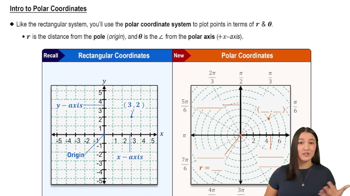
Polar coordinates represent points in a plane using a radius and an angle relative to a fixed direction, typically the positive x-axis. Each point is described by (r, θ), where r is the distance from the origin and θ is the angle measured in radians or degrees.
Video consigliato:
05:32
Intro to Polar Coordinates

Multiple Representations of the Same Point

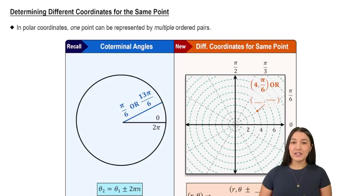
In polar coordinates, a single point can have multiple representations because adding or subtracting full rotations (2π radians) to the angle or using negative radius values can yield equivalent positions. For example, the origin (r=0) is represented by any angle θ.
Video consigliato:
6:02
Determining Different Coordinates for the Same Point

The Origin in Polar Coordinates

The origin in polar coordinates is unique because its radius r is zero, making the angle θ arbitrary. This means the origin can be represented by infinitely many coordinate pairs (0, θ), highlighting the flexibility and special nature of the origin in this system.
Video consigliato:
05:32
Intro to Polar Coordinates
Pratica correlata
Domanda del libro di testo

73–76. Tangent lines Find an equation of the line tangent to the curve at the point corresponding to the given value of t.


x=cos t+t sin t,y=sin t−t cos t; t=π/4

99
views

Domanda del libro di testo

57–62. Polar equations for conic sections Graph the following conic sections, labeling the vertices, foci, directrices, and asymptotes (if they exist). Use a graphing utility to check your work.


r = 1/(2 - 2 sin θ)

23
views
Domanda del libro di testo

31–38. Equations of parabolas Find an equation of the following parabolas. Unless otherwise specified, assume the vertex is at the origin.

A parabola that opens to the right with directrix x = -4

78
views
Domanda del libro di testo

90–94. Focal chords A focal chord of a conic section is a line through a focus joining two points of the curve. The latus rectum is the focal chord perpendicular to the major axis of the conic. Prove the following properties.

Let L be the latus rectum of the parabola y ² =4px for p>0. Let F be the focus of the parabola, P be any point on the parabola to the left of L, and D be the (shortest) distance between P and L. Show that for all P, D+|FP|+ is a constant. Find the constant.

78
views
Domanda del libro di testo

Second derivative Assume a curve is given by the parametric equations x=f(t) and y=g(t), where f and g are twice differentiable. Use the Chain Rule to show that y″x=(fʹ(t)g″(t)−gʹ(t)f″(t))/(fʹ(t))³.  

43
views
Domanda del libro di testo

57–64. Graphing polar curves Graph the following equations. Use a graphing utility to check your work and produce a final graph.


r² = 4 sin θ  

54
views