
Ch.12 - Parametric and Polar Curves
Briggs - Calculus: Early Transcendentals 3rd Edition
Briggs3rd EditionCalculus: Early TranscendentalsISBN: 9780136847243Non è quello che usi tu?Cambia libro di testo
Capitolo 12, Problema 12.1.67a

67–72. Derivatives Consider the following parametric curves.
a. Determine dy/dx in terms of t and evaluate it at the given value of t.


x = 2 + 4t, y = 4 − 8t; t = 2

Guida verificata passo dopo passo
1
Identify the parametric equations given: \(x = 2 + 4t\) and \(y = 4 - 8t\).
Find the derivatives of \(x\) and \(y\) with respect to the parameter \(t\): compute \(\frac{dx}{dt}\) and \(\frac{dy}{dt}\).
Calculate \(\frac{dx}{dt}\) by differentiating \(x = 2 + 4t\) with respect to \(t\), and calculate \(\frac{dy}{dt}\) by differentiating \(y = 4 - 8t\) with respect to \(t\).
Use the formula for the derivative of \(y\) with respect to \(x\) in parametric form: \(\frac{dy}{dx} = \frac{\frac{dy}{dt}}{\frac{dx}{dt}}\).
Evaluate \(\frac{dy}{dx}\) at the given value \(t = 2\) by substituting \(t = 2\) into the expressions for \(\frac{dy}{dt}\) and \(\frac{dx}{dt}\), then compute the ratio.

Risposta video verificata per un problema simile:

Questa soluzione video è stata consigliata dai nostri tutor come utile per risolvere questo problema.
Durata del video:
1m

Concetti chiave

Ecco i concetti essenziali che devi comprendere per rispondere correttamente alla domanda.

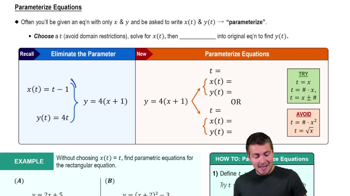
Parametric Equations

Parametric equations express the coordinates of points on a curve as functions of a parameter, usually denoted as t. Instead of y as a function of x, both x and y depend on t, allowing the description of more complex curves and motions.
Video consigliato:
08:02
Parameterizing Equations

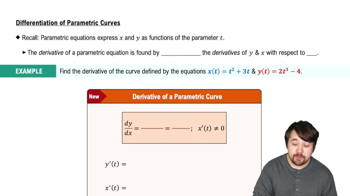
Derivative of Parametric Curves (dy/dx)

For parametric curves, the derivative dy/dx is found by dividing the derivative of y with respect to t by the derivative of x with respect to t, i.e., (dy/dt) / (dx/dt). This gives the slope of the tangent line to the curve at a given parameter value.
Video consigliato:
Percorso guidato
06:49
Differentiation of Parametric Curves

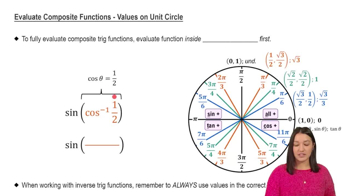
Evaluating Derivatives at a Specific Parameter Value

After finding the general expression for dy/dx in terms of t, substituting the given value of t allows calculation of the slope of the curve at that specific point. This step is essential for understanding the behavior of the curve at particular parameter values.
Video consigliato:
5:10
Evaluate Composite Functions - Values on Unit Circle
Pratica correlata
Domanda del libro di testo

Volume of a hyperbolic cap Consider the region R bounded by the right branch of the hyperbola x²/a² - y²/b² = 1 and the vertical line through the right focus.

b. What is the volume of the solid that is generated when R is revolved about the y-axis?

62
views
Domanda del libro di testo

Regions bounded by a spiral: Let Rₙ be the region bounded by the nth turn and the (n+1)st turn of the spiral r = e⁻ᶿ in the first and second quadrants, for θ ≥ 0 (see figure).

a. Find the area Aₙ of Rₙ.


76
views
Domanda del libro di testo

Channel flow Water flows in a shallow semicircular channel with inner and outer radii of 1 m and 2 m (see figure). At a point P(r,θ) in the channel, the flow is in the tangential direction (counterclock wise along circles), and it depends only on r, the distance from the center of the semicircles.


a. Express the region formed by the channel as a set in polar coordinates.

52
views
Domanda del libro di testo

Explain why or why not Determine whether the following statements are true and give an explanation or counterexample.


b. An object following the parametric curve x=2cos 2πt, y=2 sin 2πt circles the origin once every 1 time unit.

35
views
Domanda del libro di testo

Intersecting lines Consider the following pairs of lines. Determine whether the lines are parallel or intersecting. If the lines intersect, then determine the point of intersection.


a. x = 1 + s, y = 2s and x = 1 + 2t, y = 3t

63
views
Domanda del libro di testo

Volume of a hyperbolic cap Consider the region R bounded by the right branch of the hyperbola x²/a² - y²/b² = 1 and the vertical line through the right focus.

a. What is the volume of the solid that is generated when R is revolved about the x-axis?

40
views