
Ch.12 - Parametric and Polar Curves
Briggs - Calculus: Early Transcendentals 3rd Edition
Briggs3rd EditionCalculus: Early TranscendentalsISBN: 9780136847243Non è quello che usi tu?Cambia libro di testo
Capitolo 12, Problema 12.3.81a

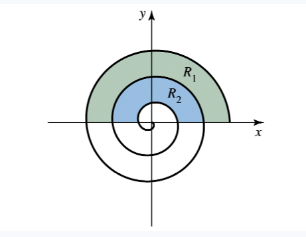
Regions bounded by a spiral: Let Rₙ be the region bounded by the nth turn and the (n+1)st turn of the spiral r = e⁻ᶿ in the first and second quadrants, for θ ≥ 0 (see figure).
a. Find the area Aₙ of Rₙ.


Spiral curve r = e^(-θ) with shaded regions R₁ and R₂ between consecutive turns in the first two quadrants.

Guida verificata passo dopo passo
1
Identify the spiral given by the polar equation \(r = e^{-\theta}\), where \(\theta \geq 0\). The regions \(R_n\) are bounded between the \(n\)th and \((n+1)\)st turns of the spiral, which correspond to \(\theta = n\pi\) and \(\theta = (n+1)\pi\) respectively, since one full turn corresponds to an increase of \(\pi\) in \(\theta\) (covering the first and second quadrants).
Recall the formula for the area of a region bounded by a polar curve between angles \(\alpha\) and \(\beta\): \(A = \frac{1}{2} \int_{\alpha}^{\beta} r^2 \, d\theta\)
Apply this formula to find the area \(A_n\) of the region \(R_n\) by integrating \(r^2 = (e^{-\theta})^2 = e^{-2\theta}\) from \(\theta = n\pi\) to \(\theta = (n+1)\pi\): \(A_n = \frac{1}{2} \int_{n\pi}^{(n+1)\pi} e^{-2\theta} \, d\theta\)
Evaluate the integral \(\int e^{-2\theta} \, d\theta\). Use the substitution method or recall that the integral of \(e^{ax}\) is \(\frac{1}{a} e^{ax}\), so here it becomes \(-\frac{1}{2} e^{-2\theta}\) plus a constant of integration.
Substitute the limits \(n\pi\) and \((n+1)\pi\) into the evaluated integral and multiply by \(\frac{1}{2}\) to express \(A_n\) in terms of \(n\). This will give the exact area of the region \(R_n\) bounded by the \(n\)th and \((n+1)\)st turns of the spiral.

Risposta video verificata per un problema simile:

Questa soluzione video è stata consigliata dai nostri tutor come utile per risolvere questo problema.
Durata del video:
4m

Concetti chiave

Ecco i concetti essenziali che devi comprendere per rispondere correttamente alla domanda.

Polar Coordinates and Curves

Polar coordinates represent points using a radius and angle (r, θ), which is essential for describing curves like spirals. The given spiral r = e^(-θ) is defined in terms of θ, making it natural to analyze areas bounded by turns using polar integration.
Video consigliato:
05:32
Intro to Polar Coordinates

Area in Polar Coordinates

The area enclosed by a curve in polar coordinates between angles θ = a and θ = b is found using the integral A = 1/2 ∫[a to b] (r(θ))^2 dθ. This formula is crucial for calculating the area of regions bounded by consecutive turns of the spiral.
Video consigliato:
05:32
Intro to Polar Coordinates

Understanding Regions Bounded by Spiral Turns

The region Rₙ lies between the nth and (n+1)st turns of the spiral, corresponding to θ values nπ/2 and (n+1)π/2 in the first and second quadrants. Identifying these angular bounds is key to setting up the integral for the area Aₙ.
Video consigliato:
Percorso guidato
04:34
Area of Polar Regions Example 3
Pratica correlata
Domanda del libro di testo

Volume of a hyperbolic cap Consider the region R bounded by the right branch of the hyperbola x²/a² - y²/b² = 1 and the vertical line through the right focus.

b. What is the volume of the solid that is generated when R is revolved about the y-axis?

62
views
Domanda del libro di testo

Tangents and normals: Let a polar curve be described by r = f(θ), and let ℓ be the line tangent to the curve at the point P(x,y) = P(r,θ) (see figure).

b. Explain why tan θ = y/x.


106
views
Domanda del libro di testo

Explain why or why not Determine whether the following statements are true and give an explanation or counterexample.


b. An object following the parametric curve x=2cos 2πt, y=2 sin 2πt circles the origin once every 1 time unit.

35
views
Domanda del libro di testo

Intersecting lines Consider the following pairs of lines. Determine whether the lines are parallel or intersecting. If the lines intersect, then determine the point of intersection.


a. x = 1 + s, y = 2s and x = 1 + 2t, y = 3t

63
views
Domanda del libro di testo

67–72. Derivatives Consider the following parametric curves.

a. Determine dy/dx in terms of t and evaluate it at the given value of t.


x = 2 + 4t, y = 4 − 8t; t = 2

50
views
Domanda del libro di testo

Volume of a hyperbolic cap Consider the region R bounded by the right branch of the hyperbola x²/a² - y²/b² = 1 and the vertical line through the right focus.

a. What is the volume of the solid that is generated when R is revolved about the x-axis?

40
views