
Ch.12 - Parametric and Polar Curves
Briggs - Calculus: Early Transcendentals 3rd Edition
Briggs3rd EditionCalculus: Early TranscendentalsISBN: 9780136847243Non è quello che usi tu?Cambia libro di testo
Capitolo 12, Problema 12.1.89b

Explain why or why not Determine whether the following statements are true and give an explanation or counterexample.


b. An object following the parametric curve x=2cos 2πt, y=2 sin 2πt circles the origin once every 1 time unit.

Guida verificata passo dopo passo
1
Identify the parametric equations given: \(x = 2\cos(2\pi t)\) and \(y = 2\sin(2\pi t)\).
Recognize that these parametric equations describe a point moving on a circle centered at the origin with radius 2, because \(x^2 + y^2 = (2\cos(2\pi t))^2 + (2\sin(2\pi t))^2 = 4(\cos^2(2\pi t) + \sin^2(2\pi t)) = 4\).
Understand that the parameter \(t\) affects the angle in the trigonometric functions as \(2\pi t\), which means the angle completes a full \(2\pi\) radians rotation when \(t\) increases by 1.
Since the angle \(2\pi t\) increases by \(2\pi\) when \(t\) goes from 0 to 1, the object completes exactly one full circle around the origin in 1 time unit.
Therefore, the statement is true because the parametric curve completes one full revolution around the origin every 1 unit of time.

Risposta video verificata per un problema simile:

Questa soluzione video è stata consigliata dai nostri tutor come utile per risolvere questo problema.
Durata del video:
4m

Concetti chiave

Ecco i concetti essenziali che devi comprendere per rispondere correttamente alla domanda.

Parametric Equations and Curves

Parametric equations express the coordinates of a point as functions of a parameter, often time. Here, x and y depend on t, tracing a path in the plane. Understanding how these functions describe motion or shape is essential to analyze the object's trajectory.
Video consigliato:
08:02
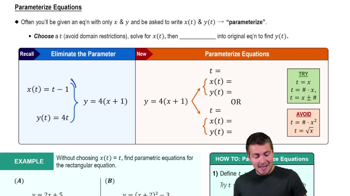
Parameterizing Equations

Periodicity of Trigonometric Functions

Sine and cosine functions are periodic with a fundamental period of 2π. When their arguments are scaled by a factor, the period changes accordingly. Recognizing how the parameter t affects the period helps determine how long it takes for the object to complete one full cycle.
Video consigliato:
Percorso guidato
6:04
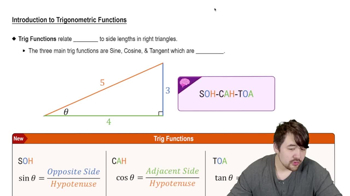
Introduction to Trigonometric Functions

Parametric Curve and Circular Motion

The given parametric equations describe circular motion with radius 2 centered at the origin. The time it takes to complete one full circle corresponds to the period of the parametric functions. Analyzing the frequency inside the trigonometric functions reveals the duration of one revolution.
Video consigliato:
Percorso guidato
06:49
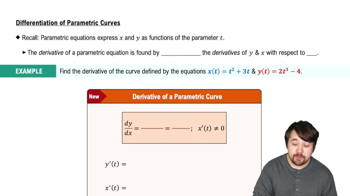
Differentiation of Parametric Curves