Ch.12 - Parametric and Polar Curves
Briggs - Calculus: Early Transcendentals 3rd Edition
Briggs3rd EditionCalculus: Early TranscendentalsISBN: 9780136847243Non è quello che usi tu?Cambia libro di testo
Capitolo 12, Problema 12.R.1a

Explain why or why not Determine whether the following statements are true and give an explanation or counterexample.
a. A set of parametric equations for a given curve is always unique.

Guida verificata passo dopo passo
1
Understand the meaning of parametric equations: Parametric equations express the coordinates of points on a curve as functions of a parameter, usually denoted as \(t\). For example, \(x = f(t)\) and \(y = g(t)\) describe a curve in the plane.
Consider the uniqueness of parametric representations: Ask yourself if there can be more than one way to describe the same curve using different parametric equations. Think about how changing the parameter or reparametrizing the curve might affect the equations.
Recall that a curve can be reparametrized: If you have one set of parametric equations \(x = f(t)\) and \(y = g(t)\), you can often create another set by substituting \(t\) with a different parameter function \(s = h(t)\), where \(h\) is a one-to-one function. This produces a different parametric form for the same curve.
Conclude about uniqueness: Since multiple parameterizations can describe the same curve, the set of parametric equations for a given curve is generally not unique.
Provide a counterexample: For instance, the circle \(x = \cos t\), \(y = \sin t\) can also be described by \(x = \cos(2t)\), \(y = \sin(2t)\), which traces the same circle but at a different speed and parameterization.

Risposta video verificata per un problema simile:

Questa soluzione video è stata consigliata dai nostri tutor come utile per risolvere questo problema.
Durata del video:
2m

Concetti chiave

Ecco i concetti essenziali che devi comprendere per rispondere correttamente alla domanda.

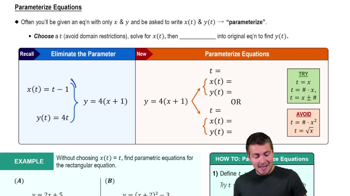
Parametric Equations

Parametric equations represent a curve by expressing the coordinates as functions of a parameter, usually denoted as t. They allow the description of curves that may not be functions in the traditional y = f(x) form, providing flexibility in representing complex paths.
Video consigliato:
08:02
Parameterizing Equations

Uniqueness of Parametric Representations

A single curve can have multiple parametric representations because different parameterizations can trace the same set of points in various ways. This means parametric equations for a curve are generally not unique, as reparameterizations or different functional forms can describe the same curve.
Video consigliato:
08:02
Parameterizing Equations

Counterexamples in Mathematics

A counterexample is a specific case that disproves a general statement or claim. To show that parametric equations are not always unique, one can provide two distinct parametric forms that generate the same curve, demonstrating the statement is false.
Video consigliato:
Percorso guidato
05:13
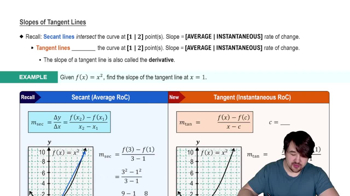
Slopes of Tangent Lines