Ch. 1 - Functions
Hass - Thomas' Calculus 15th Edition
Hass15th EditionThomas' CalculusISBN: 9780137616077Non è quello che usi tu?Cambia libro di testo
Capitolo 1, Problema 55

In Exercises 55–58, graph each function, not by plotting points, but by starting with the graph of one of the standard functions presented in Figures 1.15–1.17, and applying an appropriate transformation.
y = - √(1 + x/2)

Guida verificata passo dopo passo
1
Identify the base function: The base function here is \( y = \sqrt{x} \). This is a standard square root function.
Apply the transformation inside the square root: The expression inside the square root is \( 1 + \frac{x}{2} \). This represents a horizontal shift. Specifically, \( x \) is replaced by \( x + 2 \), which shifts the graph to the left by 2 units.
Apply the vertical reflection: The negative sign in front of the square root, \( y = -\sqrt{1 + \frac{x}{2}} \), indicates a reflection across the x-axis. This means that all y-values of the transformed function will be the opposite of the y-values of the base function.
Consider the domain: The domain of the base function \( y = \sqrt{x} \) is \( x \geq 0 \). For the transformed function \( y = -\sqrt{1 + \frac{x}{2}} \), the expression inside the square root must be non-negative, so \( 1 + \frac{x}{2} \geq 0 \). Solve this inequality to find the domain of the transformed function.
Graph the function: Start with the graph of \( y = \sqrt{x} \), apply the horizontal shift to the left by 2 units, and then reflect the graph across the x-axis. Ensure the graph only includes x-values within the domain found in the previous step.

Risposta video verificata per un problema simile:

Questa soluzione video è stata consigliata dai nostri tutor come utile per risolvere questo problema.
Durata del video:
9m

Concetti chiave

Ecco i concetti essenziali che devi comprendere per rispondere correttamente alla domanda.

Standard Functions

Standard functions are basic functions that serve as building blocks for more complex functions. Examples include linear, quadratic, cubic, and square root functions. Understanding these functions' shapes and properties is crucial for graphing transformations, as they provide a reference point for how transformations alter the graph.
Video consigliato:
6:04
Introduction to Polynomial Functions

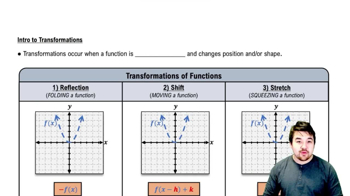
Function Transformations

Function transformations involve shifting, stretching, compressing, or reflecting a graph. For example, y = -√(1 + x/2) involves a reflection over the x-axis due to the negative sign, and a horizontal compression by a factor of 2. Recognizing these transformations helps in graphing the function without plotting individual points.
Video consigliato:
Percorso guidato
5:25
Intro to Transformations

Square Root Function

The square root function, y = √x, is a standard function with a domain of x ≥ 0 and a range of y ≥ 0. It is characterized by a gentle curve starting at the origin. Understanding its basic shape is essential when applying transformations, such as reflections or shifts, to graph functions like y = -√(1 + x/2).
Video consigliato:
03:19
Completing the Square to Rewrite the Integrand Example 6