

Ch. 1 - Functions
Hass - Thomas' Calculus 15th Edition
Hass15th EditionThomas' CalculusISBN: 9780137616077Non è quello che usi tu?Cambia libro di testo
Capitolo 1, Problema 65

In Exercises 65–68, ABC is a right triangle with the right angle at C. The sides opposite angles A, B, and C are a, b, and c, respectively.


a. Find a and b if c = 2, B = π/3.
b. Find a and c if b = 2, B = π/3.

Guida verificata passo dopo passo
1
To solve part (a), we start by using the given information: c = 2 and angle B = π/3. Since ABC is a right triangle, we can use trigonometric ratios. The side opposite angle B is b, and the hypotenuse is c.
Use the sine function for angle B: sin(B) = opposite/hypotenuse = b/c. Substitute the known values: sin(π/3) = b/2. Solve for b using the fact that sin(π/3) = √3/2.
Next, use the cosine function for angle B: cos(B) = adjacent/hypotenuse = a/c. Substitute the known values: cos(π/3) = a/2. Solve for a using the fact that cos(π/3) = 1/2.
For part (b), we are given b = 2 and angle B = π/3. We need to find a and c. Use the tangent function for angle B: tan(B) = opposite/adjacent = b/a. Substitute the known values: tan(π/3) = 2/a. Solve for a using the fact that tan(π/3) = √3.
Finally, use the Pythagorean theorem to find c: a² + b² = c². Substitute the known values for a and b to solve for c.

Risposta video verificata per un problema simile:

Questa soluzione video è stata consigliata dai nostri tutor come utile per risolvere questo problema.
Durata del video:
4m

Concetti chiave

Ecco i concetti essenziali che devi comprendere per rispondere correttamente alla domanda.

Pythagorean Theorem

The Pythagorean Theorem states that in a right triangle, the square of the length of the hypotenuse (c) is equal to the sum of the squares of the lengths of the other two sides (a and b). This relationship is expressed as a² + b² = c², and is fundamental for solving problems involving right triangles.
Video consigliato:
Percorso guidato
06:11
Fundamental Theorem of Calculus Part 1

Trigonometric Ratios

Trigonometric ratios relate the angles of a triangle to the lengths of its sides. For a right triangle, the sine, cosine, and tangent functions are defined as sin(B) = opposite/hypotenuse, cos(B) = adjacent/hypotenuse, and tan(B) = opposite/adjacent. These ratios are essential for finding unknown side lengths when angles are known.
Video consigliato:
Percorso guidato
6:04
Introduction to Trigonometric Functions

Angle Measures in Radians

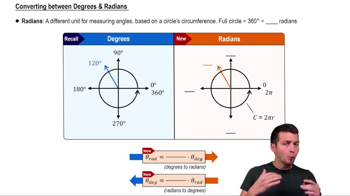
In calculus and trigonometry, angles can be measured in degrees or radians. Radians are a more natural measure for angles in mathematical analysis, where π radians correspond to 180 degrees. Understanding how to convert between these two systems is crucial for applying trigonometric functions correctly in problems involving angles.
Video consigliato:
5:04
Converting between Degrees & Radians