Ch. 10 - Infinite Sequences and Series
Hass - Thomas' Calculus 15th Edition
Hass15th EditionThomas' CalculusISBN: 9780137616077Non è quello che usi tu?Cambia libro di testo
Capitolo 10, Problema 10.6.18

Absolute and Conditional Convergence
Which of the series in Exercises 15–48 converge absolutely, which converge, and which diverge? Give reasons for your answers.
∑ (from n = 1 to ∞) [(-1)ⁿ / (1 + √n)]

Guida verificata passo dopo passo
1
Identify the given series: \( \sum_{n=1}^{\infty} \frac{(-1)^n}{1 + \sqrt{n}} \). This is an alternating series because of the factor \( (-1)^n \), which alternates the sign of each term.
To check for absolute convergence, consider the series of absolute values: \( \sum_{n=1}^{\infty} \left| \frac{(-1)^n}{1 + \sqrt{n}} \right| = \sum_{n=1}^{\infty} \frac{1}{1 + \sqrt{n}} \). Analyze whether this series converges or diverges.
Compare the absolute value series to a known benchmark series. Since \( \sqrt{n} \) grows slower than \( n \), the terms \( \frac{1}{1 + \sqrt{n}} \) behave similarly to \( \frac{1}{\sqrt{n}} \) for large \( n \). Recall that \( \sum \frac{1}{n^p} \) converges if and only if \( p > 1 \).
Since \( \sum \frac{1}{\sqrt{n}} = \sum \frac{1}{n^{1/2}} \) diverges (because \( 1/2 < 1 \)), the absolute value series diverges. Therefore, the original series does not converge absolutely.
Next, apply the Alternating Series Test to the original series: check if the terms \( b_n = \frac{1}{1 + \sqrt{n}} \) decrease monotonically to zero. Since \( b_n \) is positive, decreasing, and \( \lim_{n \to \infty} b_n = 0 \), the series converges conditionally.

Risposta video verificata per un problema simile:

Questa soluzione video è stata consigliata dai nostri tutor come utile per risolvere questo problema.
Durata del video:
3m

Concetti chiave

Ecco i concetti essenziali che devi comprendere per rispondere correttamente alla domanda.

Absolute Convergence

A series ∑a_n converges absolutely if the series of absolute values ∑|a_n| converges. Absolute convergence implies convergence regardless of the sign of the terms, and it is a stronger form of convergence that guarantees the sum is well-defined even if terms alternate in sign.
Video consigliato:
Percorso guidato
07:51
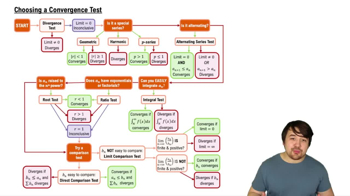
Choosing a Convergence Test

Conditional Convergence

A series ∑a_n converges conditionally if it converges, but does not converge absolutely. This typically occurs in alternating series where the terms decrease in magnitude to zero, but the series of absolute values diverges. Conditional convergence depends on the sign pattern of the terms.
Video consigliato:
Percorso guidato
07:51
Choosing a Convergence Test

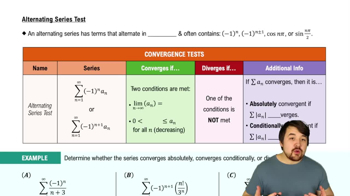
Alternating Series Test

The Alternating Series Test states that an alternating series ∑(-1)^n b_n converges if the sequence b_n is positive, decreasing, and approaches zero. This test helps determine conditional convergence when absolute convergence fails, especially for series with terms that alternate in sign.
Video consigliato:
Percorso guidato
10:54
Alternating Series Test