Ch. 10 - Infinite Sequences and Series
Hass - Thomas' Calculus 15th Edition
Hass15th EditionThomas' CalculusISBN: 9780137616077Non è quello che usi tu?Cambia libro di testo
Capitolo 10, Problema 10.3.56

Estimate the value of ∑ (from n=2 to ∞) (1 / (n² + 4)) to within 0.1 of its exact value.

Guida verificata passo dopo passo
1
Recognize that the series \( \sum_{n=2}^{\infty} \frac{1}{n^2 + 4} \) is a positive, decreasing series, which allows us to use the Integral Test or comparison tests to estimate the remainder (error) when approximating the infinite sum by a partial sum.
Calculate the partial sum \( S_N = \sum_{n=2}^{N} \frac{1}{n^2 + 4} \) for some finite \( N \). This partial sum will serve as an approximation to the infinite series.
Estimate the remainder \( R_N = \sum_{n=N+1}^{\infty} \frac{1}{n^2 + 4} \) to understand how close \( S_N \) is to the exact value. Since \( \frac{1}{n^2 + 4} < \frac{1}{n^2} \), you can use the integral test remainder estimate or compare with the integral \( \int_{N}^{\infty} \frac{1}{x^2} \, dx \) to bound the error.
Use the integral \( \int_{N}^{\infty} \frac{1}{x^2} \, dx = \frac{1}{N} \) as an upper bound for the remainder \( R_N \), which means \( R_N < \frac{1}{N} \). Choose \( N \) such that \( \frac{1}{N} < 0.1 \) to ensure the approximation is within 0.1 of the exact value.
Sum the terms up to this \( N \) to get \( S_N \), and state that \( S_N \) approximates the infinite sum \( \sum_{n=2}^{\infty} \frac{1}{n^2 + 4} \) with an error less than 0.1.

Risposta video verificata per un problema simile:

Questa soluzione video è stata consigliata dai nostri tutor come utile per risolvere questo problema.
Durata del video:
11m

Concetti chiave

Ecco i concetti essenziali che devi comprendere per rispondere correttamente alla domanda.

Infinite Series and Convergence

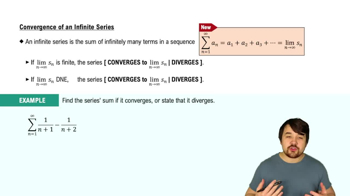
An infinite series is the sum of infinitely many terms. Understanding whether the series converges (approaches a finite value) is essential before estimating its sum. For series with positive decreasing terms, convergence can often be tested using comparison or integral tests.
Video consigliato:
Percorso guidato
06:52
Convergence of an Infinite Series

Partial Sums and Remainder Estimation

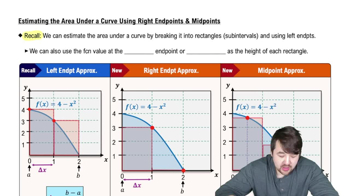
Partial sums add a finite number of terms from the series to approximate the total sum. The remainder (or tail) is the difference between the infinite sum and the partial sum. Estimating this remainder helps determine how close the partial sum is to the exact value.
Video consigliato:
Percorso guidato
05:59
Estimating the Area Under a Curve with Right Endpoints & Midpoint

Integral Test for Remainder Bounds

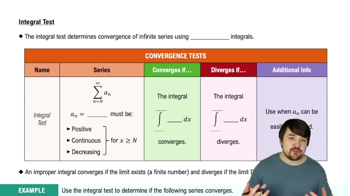
The integral test compares a series to an improper integral to assess convergence and estimate the remainder. For a decreasing positive function f(n), the remainder after N terms is bounded by integrals of f(x) from N to infinity, providing a way to estimate the error in partial sums.
Video consigliato: