Ch. 10 - Infinite Sequences and Series
Hass - Thomas' Calculus 15th Edition
Hass15th EditionThomas' CalculusISBN: 9780137616077Non è quello che usi tu?Cambia libro di testo
Capitolo 10, Problema 10.7.39

In Exercises 37–42, find the series’ radius of convergence.
∑ (from n = 1 to ∞) [ (n!)² / (2ⁿ (2n)!) ] xⁿ

Guida verificata passo dopo passo
1
Identify the general term of the series as \( a_n = \frac{(n!)^2}{2^n (2n)!} x^n \). Our goal is to find the radius of convergence \( R \) of the power series \( \sum_{n=1}^\infty a_n \).
Use the Ratio Test to find the radius of convergence. Consider the limit \( L = \lim_{n \to \infty} \left| \frac{a_{n+1}}{a_n} \right| \). The radius of convergence \( R \) is given by \( R = \frac{1}{L} \) if the limit exists.
Write out the ratio \( \left| \frac{a_{n+1}}{a_n} \right| = \frac{\frac{((n+1)!)^2}{2^{n+1} (2(n+1))!} |x|^{n+1}}{\frac{(n!)^2}{2^n (2n)!} |x|^n} = \frac{((n+1)!)^2}{(n!)^2} \cdot \frac{2^n}{2^{n+1}} \cdot \frac{(2n)!}{(2(n+1))!} \cdot |x| \).
Simplify the factorial expressions: \( \frac{((n+1)!)^2}{(n!)^2} = (n+1)^2 \), \( \frac{2^n}{2^{n+1}} = \frac{1}{2} \), and \( \frac{(2n)!}{(2n+2)!} = \frac{1}{(2n+1)(2n+2)} \). Substitute these back into the ratio.
Express the limit \( L = \lim_{n \to \infty} (n+1)^2 \cdot \frac{1}{2} \cdot \frac{1}{(2n+1)(2n+2)} \cdot |x| \). Analyze this limit to find \( L \) in terms of \( |x| \), then solve \( L < 1 \) to determine the radius of convergence \( R \).

Risposta video verificata per un problema simile:

Questa soluzione video è stata consigliata dai nostri tutor come utile per risolvere questo problema.
Durata del video:
6m

Concetti chiave

Ecco i concetti essenziali che devi comprendere per rispondere correttamente alla domanda.

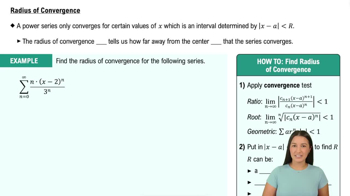
Radius of Convergence

The radius of convergence of a power series is the distance from the center of the series within which the series converges absolutely. It can be found using tests like the Ratio Test or Root Test, and it determines the interval on the x-axis where the series represents a valid function.
Video consigliato:
07:36
Radius of Convergence

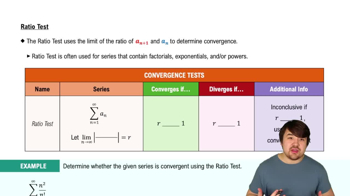
Ratio Test for Series Convergence

The Ratio Test involves taking the limit of the absolute value of the ratio of consecutive terms in a series. If this limit is less than one, the series converges; if greater than one, it diverges. This test is especially useful for power series to find the radius of convergence.
Video consigliato:

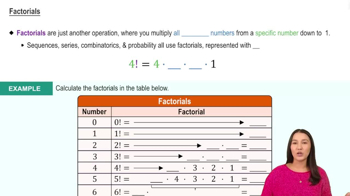
Factorials and Their Growth

Factorials (n!) grow very rapidly and often dominate the behavior of series terms. Understanding how factorial expressions behave, especially in ratios like (n!)²/(2n)!, is crucial for simplifying terms and applying convergence tests effectively.
Video consigliato:
5:22
Factorials