Estimate the value of ∑ (from n=2 to ∞) (1 / (n² + 4)) to within 0.1 of its exact value.
Ch. 10 - Infinite Sequences and Series
Capitolo 10, Problema 10.2.1
Finding nth Partial Sums
In Exercises 1–6, find a formula for the nth partial sum of each series and use it to find the series’ sum if the series converges.
2 + (2/3) + (2/9) + (2/27) + … + (2 / 3ⁿ⁻¹) + …
Guida verificata passo dopo passo1
Identify the type of series given. Notice that the series is 2 + \(\frac{2}{3}\) + \(\frac{2}{9}\) + \(\frac{2}{27}\) + \(\dots\), which is a geometric series where each term is multiplied by \(\frac{1}{3}\) to get the next term.
Write the general term of the series. The first term a is 2, and the common ratio r is \(\frac{1}{3}\). So, the nth term can be expressed as a_n = 2 \(\times\) \(\left\)(\(\frac{1}{3}\)\(\right\))^{n-1}.
Use the formula for the nth partial sum of a geometric series: S_n = a \(\times\) \(\frac{1 - r^n}{1 - r}\). Substitute a = 2 and r = \(\frac{1}{3}\) into this formula to get S_n.
Simplify the expression for S_n by plugging in the values and rewriting the formula clearly: S_n = 2 \(\times\) \(\frac{1 - \left(\frac{1}{3}\)\(\right\))^n}{1 - \(\frac{1}{3}\)}.
Determine if the series converges by examining the limit of S_n as n approaches infinity. Since |r| = \(\frac{1}{3}\) < 1, the series converges, and the sum to infinity is S = \(\frac{a}{1 - r}\).

Risposta video verificata per un problema simile:
Questa soluzione video è stata consigliata dai nostri tutor come utile per risolvere questo problema.
Durata del video:
3mConcetti chiave
Ecco i concetti essenziali che devi comprendere per rispondere correttamente alla domanda.
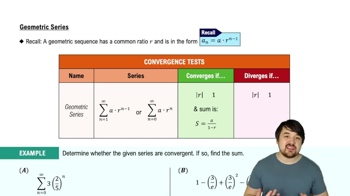
Geometric Series
A geometric series is a sum of terms where each term is found by multiplying the previous term by a constant ratio. In this problem, the series has a common ratio of 1/3, making it geometric. Understanding this helps in finding a general formula for the nth partial sum.
Video consigliato:
Percorso guidato
Geometric Series
Nth Partial Sum Formula
The nth partial sum of a geometric series is given by S_n = a(1 - r^n) / (1 - r), where a is the first term and r is the common ratio. This formula allows calculation of the sum of the first n terms, which is essential for analyzing convergence and total sums.
Video consigliato:
Percorso guidato
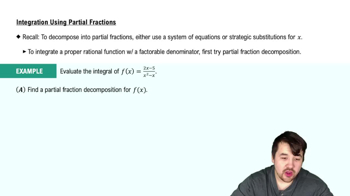
Integration Using Partial Fractions
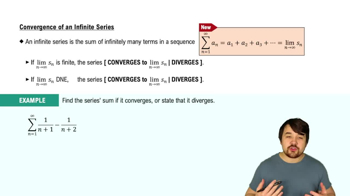
Convergence of Infinite Series
An infinite geometric series converges if the absolute value of the common ratio is less than 1. When it converges, the sum approaches S = a / (1 - r) as n approaches infinity. Recognizing convergence is key to determining the series’ total sum.
Video consigliato:
Percorso guidato
Convergence of an Infinite Series
Pratica correlata
Domanda del libro di testo
25
views
Domanda del libro di testo
Determining Convergence or Divergence
Which of the series in Exercises 17–56 converge, and which diverge? Use any method, and give reasons for your answers.
∑ (from n=1 to ∞) sin (1/n)
29
views
Domanda del libro di testo
Recursively Defined Sequences
In Exercises 101–108, assume that each sequence converges and find its limit.
a₁ = 5,aₙ₊₁ = √(5aₙ)
27
views
Domanda del libro di testo
In Exercises 37–42, find the series’ radius of convergence.
∑ (from n = 1 to ∞) [ (n!)² / (2ⁿ (2n)!) ] xⁿ
5
views
Domanda del libro di testo
Finding a Sequence’s Formula
In Exercises 13–30, find a formula for the nth term of the sequence.
2, 6, 10, 14, 18, …Every other even positive integer
28
views
Domanda del libro di testo
Use power series operations to find the Taylor series at x = 0 for the functions in Exercises 13–30.
sin x – x + (x³ / 3!)
49
views