Ch. 11 - Parametric Equations and Polar Coordinates
Hass - Thomas' Calculus 15th Edition
Hass15th EditionThomas' CalculusISBN: 9780137616077Non è quello che usi tu?Cambia libro di testo
Capitolo 11, Problema 11.3.9c

Cartesian to Polar Coordinates


Find the polar coordinates, 0 ≤ θ ≤ 2π and r ≤ 0, of the following points given in Cartesian coordinates.


c. (−1, √3)

Guida verificata passo dopo passo
1
Recall the formulas to convert Cartesian coordinates \((x, y)\) to polar coordinates \((r, \theta)\): \(r = \sqrt{x^2 + y^2}\) \(\theta = \arctan\left(\frac{y}{x}\right)\), but be careful to determine the correct quadrant for \(\theta\).
Substitute the given point \((-1, \sqrt{3})\) into the formula for \(r\): \(r = \sqrt{(-1)^2 + (\sqrt{3})^2} = \sqrt{1 + 3}\).
Calculate \(r\) from the expression above (do not finalize the numeric value here, just set up the expression).
Find the angle \(\theta\) by substituting \(x = -1\) and \(y = \sqrt{3}\) into \(\theta = \arctan\left(\frac{y}{x}\right) = \arctan\left(\frac{\sqrt{3}}{-1}\right)\).
Determine the correct quadrant for \(\theta\) since \(x\) is negative and \(y\) is positive, which places the point in the second quadrant. Adjust \(\theta\) accordingly to ensure \(0 \leq \theta \leq 2\pi\).

Risposta video verificata per un problema simile:

Questa soluzione video è stata consigliata dai nostri tutor come utile per risolvere questo problema.
Durata del video:
6m

Concetti chiave

Ecco i concetti essenziali che devi comprendere per rispondere correttamente alla domanda.

Conversion between Cartesian and Polar Coordinates

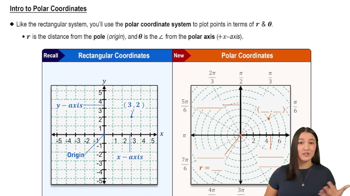
This concept involves translating a point from the Cartesian coordinate system (x, y) to the polar coordinate system (r, θ). The radius r is the distance from the origin to the point, calculated as r = √(x² + y²), and the angle θ is the counterclockwise angle from the positive x-axis, found using θ = arctan(y/x), adjusted for the correct quadrant.
Video consigliato:
05:32
Intro to Polar Coordinates

Determining the Correct Angle θ in Polar Coordinates

Since arctan(y/x) only returns values between -π/2 and π/2, it is essential to consider the signs of x and y to place θ in the correct quadrant. For points in different quadrants, θ may need to be adjusted by adding π or 2π to ensure it lies within the interval 0 ≤ θ ≤ 2π.
Video consigliato:
05:32
Intro to Polar Coordinates

Interpretation of Negative Radius r in Polar Coordinates

While r is typically non-negative, polar coordinates allow r to be negative, which means the point is located in the direction opposite to the angle θ. If r ≤ 0, the angle θ is adjusted by adding π to point in the opposite direction, effectively representing the same point with a negative radius.
Video consigliato:
05:32
Intro to Polar Coordinates