Ch. 11 - Parametric Equations and Polar Coordinates
Hass - Thomas' Calculus 15th Edition
Hass15th EditionThomas' CalculusISBN: 9780137616077Non è quello che usi tu?Cambia libro di testo
Capitolo 11, Problema 11.3.6c

Polar to Cartesian Coordinates


Find the Cartesian coordinates of the following points, given in polar coordinates.


c. (0, π/2)

Guida verificata passo dopo passo
1
Recall the formulas to convert from polar coordinates \((r, \theta)\) to Cartesian coordinates \((x, y)\):
\[x = r \cdot \cos(\theta)\]
\[y = r \cdot \sin(\theta)\]
Substitute the given polar coordinates \((r, \theta) = (0, \frac{\pi}{2})\) into the formulas:
Calculate the values of \(x\) and \(y\) using the substituted values without simplifying the final numeric result.

Risposta video verificata per un problema simile:

Questa soluzione video è stata consigliata dai nostri tutor come utile per risolvere questo problema.
Durata del video:
1m

Concetti chiave

Ecco i concetti essenziali che devi comprendere per rispondere correttamente alla domanda.

Polar Coordinates

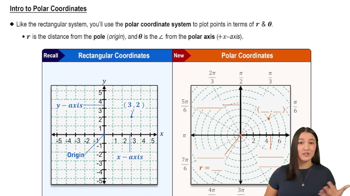
Polar coordinates represent a point in the plane using a radius and an angle, denoted as (r, θ). The radius r is the distance from the origin, and θ is the angle measured from the positive x-axis, usually in radians.
Video consigliato:
05:32
Intro to Polar Coordinates

Conversion Formulas from Polar to Cartesian

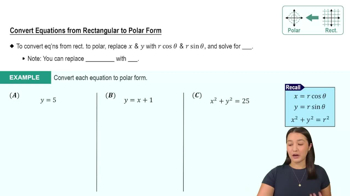
To convert polar coordinates (r, θ) to Cartesian coordinates (x, y), use the formulas x = r * cos(θ) and y = r * sin(θ). These relate the radius and angle to horizontal and vertical distances.
Video consigliato:
3:37
Convert Equations from Rectangular to Polar

Special Case: Zero Radius

When the radius r is zero, the point is at the origin regardless of the angle θ. This means the Cartesian coordinates are always (0, 0) for any angle if r = 0.
Video consigliato:
Percorso guidato
04:24
Graphing The Derivative - Special Cases